



A Lonely Outpost in the Void
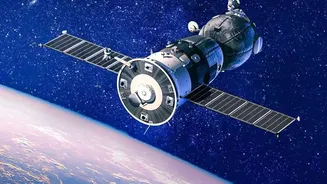
Launched nearly fifty years ago, the Interstellar Explorer is humanity’s most distant emissary. It and its twin probe have journeyed billions of kilometres from home, past the orbits of the outer planets, and into the uncharted territory between the stars.
These probes are the only human-made objects to directly sample the interstellar medium, the thin sea of particles and radiation that fills the galaxy. They are, in essence, our first true outposts in the cosmos, built with technology that now seems ancient—their onboard computers have less memory than a modern car key fob—yet they continue to perform groundbreaking science.
The Inevitable Decline
The source of the Explorer’s longevity is also the cause of its current predicament. The probe is not powered by solar panels, which would be useless so far from the Sun. Instead, it relies on a Radioisotope Thermoelectric Generator (RTG), which converts the heat from the natural decay of plutonium into electricity. This nuclear battery has provided reliable power for decades, but it is a finite resource. Every year, the heat—and thus the available electricity—declines by about 4 watts. This steady loss of power forces mission controllers into a constant battle against the cold and silence of space, as they decide which systems to power down to keep the most critical science instruments alive.
The 'Big Bang' Fix
The latest in a long line of ingenious solutions has been nicknamed the “Big Bang” by the mission team at NASA's Jet Propulsion Laboratory. The challenge was that another science instrument was scheduled to be shut down before the end of 2026 to conserve power. To avoid this, engineers devised a plan to reroute power in a way never before attempted. They identified a set of onboard heaters and other powered devices that could be turned off, but this carried a huge risk. Without their heaters, the spacecraft’s components could freeze in the near-absolute-zero temperatures of interstellar space. In a carefully coordinated maneuver sent across billions of kilometres, the team turned off multiple devices at once and substituted them with lower-power alternatives to keep the spacecraft just warm enough to function. The commands, travelling at the speed of light, took nearly a full day just to reach the probe.
Buying Precious Time for Science
The high-stakes gambit paid off. NASA confirmed the “Big Bang” maneuver was successful, freeing up enough power to postpone the next instrument shutdown. This single fix is expected to allow the Explorer’s three remaining active science instruments—which measure cosmic rays, plasma waves, and magnetic fields—to continue operating together for at least another year. This isn’t a permanent solution, as the power supply will continue to diminish, but it represents another victory for engineering creativity. Every extra day of data from the probe provides priceless information about the boundary of our sun's influence and the environment outside it. Following the success on this probe (technically Voyager 2), the agency plans to perform a similar power-saving swap on its even more distant twin (Voyager 1) in the coming months.
A Legacy That Refuses to End
Why go to such extraordinary lengths for a half-century-old piece of hardware? Because the Interstellar Explorer is more than just a machine. It represents a generation of ambition and a testament to long-term thinking. The data it sends back is completely unique, offering us a direct line to the galaxy beyond our home. It has reshaped our understanding of the solar system and our place in the universe. Each fix, each workaround, is a masterclass in remote engineering, conducted on a patient that is nearly a light-day away. While the probes may eventually fall silent sometime in the 2030s, their journey will continue, carrying their famous Golden Records into the void for eternity.