








The High-Rise Ventilation Headache
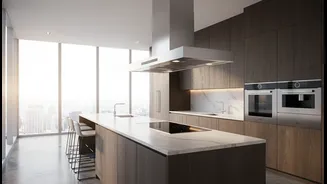
Living in a tall building in India comes with unique challenges for kitchen ventilation. Unlike standalone houses, you can't simply knock a hole in the wall to vent cooking fumes outside. High-rise buildings are designed as sealed structures for efficiency
and safety. This means apartments share walls, and external modifications are heavily restricted by the builder and the residents' welfare association. The result is that smoke from tempering spices, the oily residue from frying, and strong odours can get trapped, circulating within your home, clinging to furniture, and sometimes even bothering neighbours. The core problem is that the very nature of a high-rise makes traditional, direct-to-outside venting difficult, if not impossible.
Decoding the Building Rules
Every construction project in India, including high-rises, must adhere to the National Building Code (NBC). The NBC lays down guidelines to ensure safety, hygiene, and adequate ventilation. For kitchens, it mandates things like window openings and the installation of exhaust systems. However, these codes are often a baseline. Your specific apartment complex will have its own set of bylaws, which are usually stricter. These rules typically prohibit residents from drilling holes in the external walls for ducts. This is done to maintain the structural integrity of the building, prevent fire spread between floors, and preserve the building's exterior appearance. So, while a ducted chimney that vents outside is the most effective solution, it's often not a permitted one in an apartment setting.
The Ducting Dilemma: To Vent or Not to Vent?
This leaves residents with a choice between two main types of kitchen chimneys: ducted and ductless. A ducted chimney physically expels smoke, grease, and odours from your kitchen to the outdoors through a pipe. This is highly effective, especially for the heavy, oily, and spice-rich nature of Indian cooking. However, as noted, installing the required ducting is a major hurdle in high-rises. Ductless chimneys, on the other hand, do not vent outside. Instead, they pull in the air, pass it through a series of filters, and recirculate it back into the kitchen. This makes them incredibly easy to install anywhere, with no need for structural changes, which is why they are often the only viable option for apartment dwellers.
The Smart Solution: Ductless Chimneys
For most high-rise kitchens, a high-quality ductless (or recirculating) chimney is the most practical solution. These units work by using grease filters (like baffle or mesh filters) to trap oil particles, and then activated carbon filters to absorb odours. The 'cleaned' air is then released back into the room. While they are generally considered less powerful than ducted models, modern ductless chimneys have become much more efficient. When choosing one, don't just look at the design. Pay attention to the filter quality, as the carbon filters will need to be replaced periodically—typically every six to nine months, depending on your cooking habits. This recurring cost is a trade-off for the convenience and compliance with building rules.
Beyond the Chimney: A Complete Strategy
A chimney alone isn't a magic bullet. For the best results, think of ventilation as a complete system. If you have a window in your kitchen, opening it while cooking can create cross-ventilation, helping to clear the air. A simple window fan, set to exhaust, can also work wonders in pulling cooking smells out. Ensure there is a source of 'make-up air'—a slightly open window or door elsewhere—to replace the air the chimney is trying to circulate. Without it, you create a vacuum, and the chimney's motor has to strain, reducing its effectiveness. Finally, regular maintenance is key. Clean your grease filters frequently and replace carbon filters as recommended by the manufacturer to keep your system working efficiently and safely.