


Mount Etna, Italy: Europe's Restless Giant
Dominating the skyline of eastern Sicily, Mount Etna is one of the world's most active and iconic volcanoes. Visitors can take a cable car and specialized 4x4 vehicles to ascend its slopes, traversing a landscape of dark lava fields and steaming craters
that feels otherworldly. Depending on the volcanic activity, guided treks can take you to observe recent lava flows and fumaroles. The views stretching to the Ionian Sea are breathtaking. As one of the most monitored volcanoes globally, Italy's National Institute of Geophysics and Volcanology (INGV) maintains a dense network of seismic sensors, GPS stations, cameras, and gas-monitoring equipment. This real-time data allows authorities to regulate access to summit areas, ensuring that the incredible spectacle can be witnessed without compromising safety.
Kīlauea, USA: A Window into Creation
Located within Hawaiʻi Volcanoes National Park, Kīlauea offers a front-row seat to the process of island formation. It is one of the most active volcanoes on Earth, with eruptions that can create dramatic lava fountains and glowing lava lakes. Visitors can explore a variety of marked trails and overlooks around the caldera, drive along the Crater Rim Drive, and walk through the historic Nāhuku (Thurston) Lava Tube. The U.S. Geological Survey's Hawaiian Volcano Observatory (HVO) provides constant updates and detailed monitoring. Scientists use seismometers, GPS, and gas sensors to track magma movement and issue timely alerts. This allows the National Park Service to manage access dynamically, closing or opening areas to provide safe viewing opportunities whenever possible.
Mount Fuji, Japan: The Sacred Summit
Though it hasn't erupted since 1707, Mount Fuji is an active stratovolcano and Japan's most famous landmark. Each summer, hundreds of thousands of people make the pilgrimage to its summit, a challenging but rewarding climb that offers unparalleled sunrise views. The climbing season is short and highly regulated, with four main trails leading to the top. The Japan Meteorological Agency (JMA) continuously watches Fuji, maintaining it at Volcanic Alert Level 1, which signifies a normal state. An extensive network of monitoring equipment, including seismometers and ground deformation sensors, is in place to detect any signs of unrest long before they would pose a risk to the public, ensuring the safety of the millions who live in its shadow and the many who ascend its slopes.
Volcanoes of Iceland: The Land of Fire and Ice
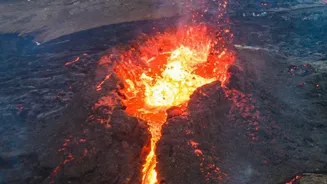
Iceland is a hotbed of volcanic activity, with over 30 active systems. Recent eruptions on the Reykjanes Peninsula have captured global attention, offering incredible but accessible spectacles. Tour operators lead guided hikes to view fresh lava fields and steaming craters when conditions are deemed safe. The landscape is a raw, powerful mix of hardened black lava and vibrant moss. The Icelandic Meteorological Office (IMO) is a world leader in volcanic surveillance, using a sophisticated network of seismometers, GPS sensors, and satellite data to provide real-time updates on volcanic unrest. This robust system allows authorities to manage exclusion zones and provide clear guidance, making it possible for tourism to coexist with the country’s dynamic geology.
Mount Rainier, USA: A Glaciated Peak
Towering over the Seattle metropolitan area, Mount Rainier is a majestic, ice-clad volcano considered one of the most dangerous in the United States due to its potential for lahars, or volcanic mudflows. Yet, Mount Rainier National Park is a popular destination for hiking, climbing, and wildlife viewing. Trails wind through ancient forests and alpine meadows with stunning views of the peak. The USGS Cascades Volcano Observatory (CVO) works closely with the Pacific Northwest Seismic Network to monitor every tremor and shift. A state-of-the-art lahar detection system was installed to provide early warnings to surrounding communities. For visitors in the park, this scientific oversight ensures that any signs of unrest would be detected well in advance, allowing for a peaceful experience on the beautiful mountain.
Arenal, Costa Rica: The Eco-Tourism Icon
Although Arenal Volcano entered a dormant phase in 2010 after 42 years of continuous eruptions, it remains an iconic and active volcano that anchors a vibrant tourism region. Visitors flock to the area for its lush rainforests, hot springs heated by the volcano's geothermal energy, and hiking trails that cross lava fields from past eruptions. From the Arenal Observatory Lodge, originally a Smithsonian Institution research station, you can get incredible views. Costa Rica's Volcanological and Seismological Observatory (OVSICORI-UNA) constantly monitors Arenal. Seismic stations and gas-monitoring equipment ensure that even the slightest change in its 'calm' alert level would be immediately reported, safeguarding the lodges, trails, and towns that thrive in its shadow.