

An Ambitious First for Starship
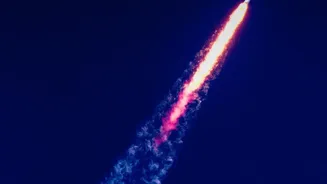
The plan for Starship's 14th test flight was the most ambitious to date. After 13 suborbital tests, this mission aimed to be the first to achieve a full orbit around Earth. The flight plan originally called for the massive rocket to circle the globe six
times over nearly 10 hours, a crucial endurance test to prove its readiness for future commercial satellite deployments and NASA's Artemis moon program. The flight also carried its first operational payload: 26 next-generation Starlink V3 satellites, designed to significantly boost the capacity of SpaceX's satellite internet service. Lifting off from Starbase in Texas, the mission was designed to end with a controlled splashdown in the Pacific Ocean, gathering invaluable data every step of the way. For the world's most powerful rocket, this was not just another test; it was its orbital debut.
Drama During the Ascent
The flight's critical moment came shortly after the Starship upper stage separated from its Super Heavy booster. As it climbed toward space, one of its six powerful Raptor engines shut down prematurely. On the live broadcast, tension was palpable as flight controllers frantically deliberated whether to abort the push for orbit. For several minutes, it seemed the primary mission objective might be scrubbed. However, after a rapid assessment of the vehicle's health, engineers determined the remaining engines could compensate. The call came through Mission Control: "Go for orbit." A single engine fired again, providing the final nudge needed to push Starship into a stable orbit for the very first time, a milestone met with cheers from the SpaceX team.
A Calculated Change of Plans
Despite successfully reaching orbit and deploying all 26 Starlink satellites, the mission did not proceed as originally planned. Citing an "abundance of caution" due to the engine issue experienced during ascent, SpaceX decided to shorten the flight significantly. Instead of completing six orbits over 10 hours, the flight was rerouted for a splashdown after just a couple of laps around the Earth. The revised mission concluded after about three hours with a controlled reentry and splashdown in the Pacific Ocean north of Hawaii. While the spacecraft exploded in a fireball upon hitting the water, this was not entirely unexpected for a test flight where recovery was not a planned objective. The decision showcased real-time risk management, prioritising data collection from a successful orbital insertion and payload deployment over the longer duration flight.
A 'Successful Failure' in Context
The mixed results of Flight 14 are classic SpaceX. The company's development philosophy famously involves pushing hardware to its limits, learning from anomalies, and iterating quickly. An engine failure that would be a major crisis for other launch providers is treated as a valuable data point. This flight successfully achieved its primary goals: reaching orbit and deploying a payload. These achievements are massive steps forward for the Starship program. However, the engine anomaly also highlights recurring challenges. Previous test flights in May and July 2026 also experienced engine issues, raising questions about the reliability of the Raptor engines that are critical for future missions, including crewed flights for NASA. Engineers now face the task of determining whether this was an isolated component failure or a symptom of a deeper design issue that could require more significant fixes.
What This Means for the Future
Reaching orbit is a landmark achievement that keeps the Starship program moving toward its ultimate goals of deep-space travel and supporting NASA's return to the Moon. However, the persistent engine issues could impact the timeline. The Artemis program, which plans to use a version of Starship to land astronauts on the lunar surface as early as 2028, depends on the vehicle's proven reliability. Before carrying humans, Starship must demonstrate flawless performance. The data gathered from Flight 14's ascent, engine anomaly, orbital operations, and reentry will be crucial for engineers to analyse and implement fixes. The next major milestone for the program will be attempting to catch a returning booster with the launch tower's mechanical arms, a key step toward the rapid reusability that is central to SpaceX's business model. While a step forward, this flight underscores that the road to making Starship a fully operational and dependable rocket remains challenging.