


A Planet's Hidden Pulse
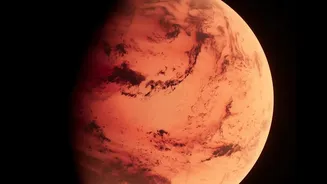
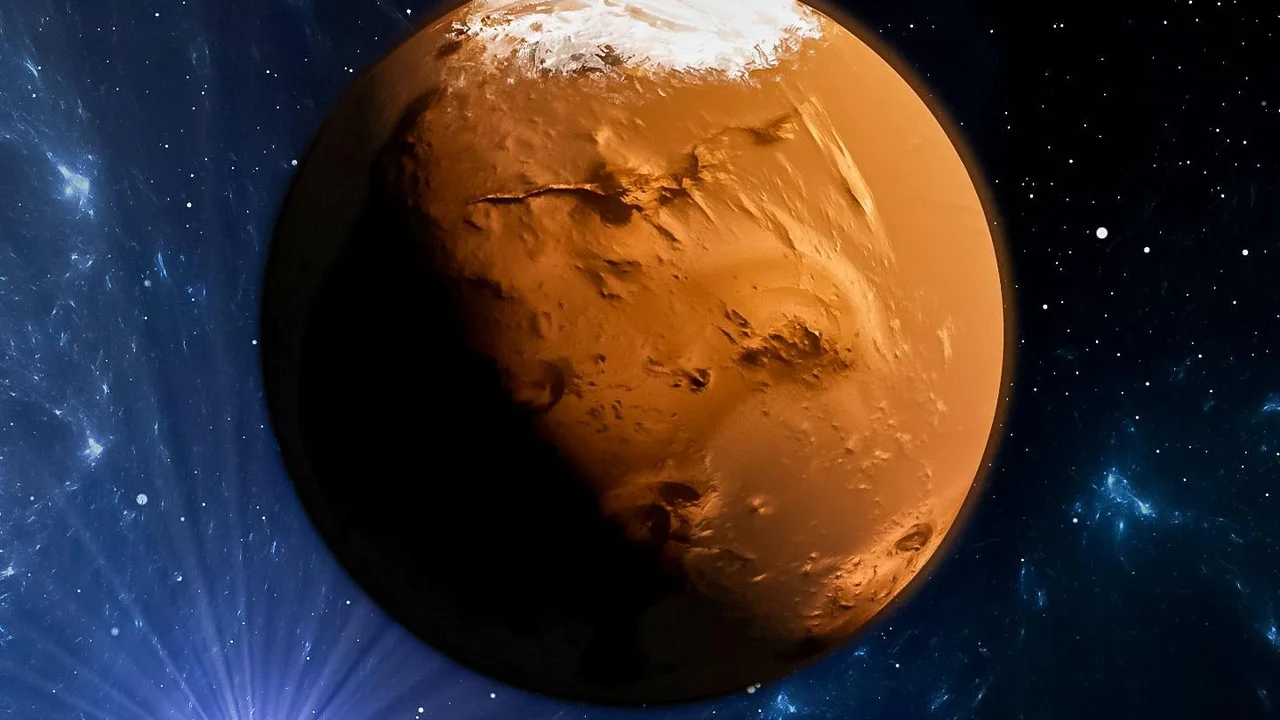
At first glance, Mars appears to be a world defined by its stark, cold, and quiet landscape. Its atmosphere is a wispy shadow of Earth's, composed mostly of carbon dioxide and with a surface pressure less than one percent of our own. Yet, this fragile
envelope is far from static. It pulses with enormous, planet-sized waves of temperature and pressure, phenomena that are largely invisible but fundamentally shape the Martian climate. These are not waves in the oceanic sense, but rather vast, oscillating patterns within the atmosphere itself, driven by the daily cycle of solar heating. Understanding these atmospheric tides and waves is like learning to read the planet's heartbeat, revealing how energy and particles—including vital dust and scarce water vapor—move around the globe.
Riding the Thermal Tides
The primary drivers of this atmospheric motion are known as thermal tides. Just as the Moon’s gravity creates tides in Earth’s oceans, the Sun’s intense heating of the Martian dayside causes the thin atmosphere to bulge and expand upwards. As Mars rotates, this bulge travels across the planet. This daily expansion and subsequent nighttime contraction creates massive pressure differences that drive powerful winds. But it gets more complex. Mars's dramatic topography, from the soaring Olympus Mons volcano to the vast Hellas Planitia basin, disrupts this flow, creating other kinds of disturbances like gravity waves and Kelvin waves. Unlike on Earth, where large-scale Rossby waves dominate stratospheric circulation, these smaller-scale waves have a much more significant impact on Mars, playing a key role in driving air currents at high altitudes.
How Scientists See the Invisible
So how do you observe something as ethereal as a temperature wave on another planet? The key has been long-term orbital observation. NASA's Mars Reconnaissance Orbiter (MRO), circling the planet since 2006, carries a crucial instrument called the Mars Climate Sounder (MCS). The MCS stares at the limb of the planet—the thin profile of the atmosphere against the blackness of space—and measures temperature, dust, and water vapor concentrations at different altitudes. By taking these vertical profiles repeatedly as it orbits, the MCS builds up a three-dimensional weather map. Over many years, scientists can analyze this rich dataset to spot the faint, repeating patterns of these thermal waves and distinguish them from random weather noise, revealing their structure, speed, and impact.
Connecting the Dots: Dust, Ice, and Weather
These waves are not just an academic curiosity; they are a critical piece of the Martian climate puzzle. They act as a global transportation system. The energy they carry helps to explain mysterious warm layers high in the polar winter atmosphere, where it should otherwise be frigidly cold. More importantly, these waves can lift and carry fine particles of dust and water ice crystals from the lower atmosphere to much higher altitudes. This process is believed to be a crucial factor in the formation of high-altitude carbon dioxide ice clouds, which were a puzzle for years because climate models suggested those altitudes were too warm for CO2 to freeze. The waves create temporary cold pockets that allow the ice to form. This vertical mixing also helps explain how the planet's infamous global dust storms can escalate, as dust lifted high into the atmosphere absorbs more sunlight and further energizes the climate system.
Why Mars's Weather Matters
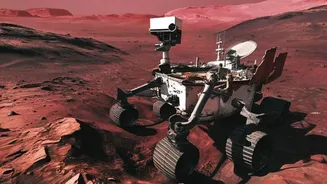
A detailed understanding of Martian atmospheric circulation is essential for the future of Mars exploration. For robotic missions, it means better weather forecasting to protect solar-powered rovers from dust storms that can block sunlight for weeks. For future human missions, predicting weather is a matter of safety. Astronauts will need to know about wind speeds for landing, dust storm risks, and the extreme temperature swings that these atmospheric tides can influence. Furthermore, studying how Mars's climate works—and how it loses atmosphere to space, a process also influenced by wave activity—provides a crucial point of comparison for understanding planetary atmospheres in general, including the long-term evolution of our own.