




The Three-Part Gauntlet
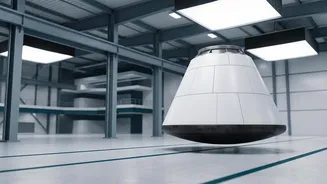
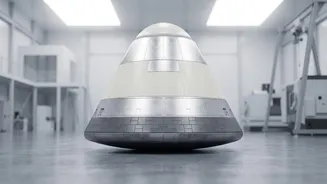
In its quest to ensure the Gaganyaan mission is as safe as humanly possible, the Indian Space Research Organisation (ISRO) recently completed three major qualification tests for the crew module. These weren't just routine checks; they were simulations
of critical moments in the spacecraft's journey where failure is not an option. The first test validated the Crew Module Up-righting System (CMUS), a clever system of gas-powered inflatable floats designed to ensure the capsule orients itself correctly after splashing down in the ocean, a vital step for a safe recovery. The second focused on the umbilical connection system that links the crew module with the service module, ensuring a clean separation before re-entry. Finally, engineers tested the structural integrity of the module to withstand the force of the apex cover separation—the event that precedes the deployment of the life-saving parachutes. These successful tests move India's human spaceflight ambition one giant leap closer to reality.
A Capsule Designed for Survival
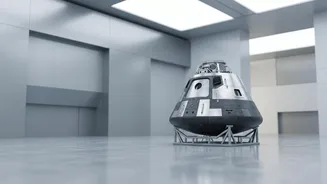
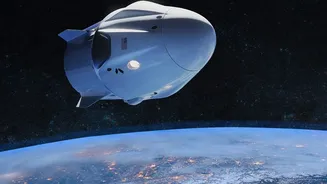
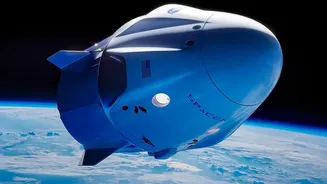
The Gaganyaan crew module is more than just a cabin; it's a multi-layered survival cell. Its primary job is to keep its occupants alive in the vacuum of space and protect them from the fiery ordeal of re-entry. To do this, every single component must work perfectly, and in perfect sequence. The tests address moments in the mission that are entirely automated and beyond the control of the astronauts inside. For example, after its mission in low-Earth orbit, the service module, which provides power and propulsion, must detach cleanly. Moments later, just before the parachutes are deployed, the apex cover that protects them must also separate without damaging the capsule's structure. And after a scorching descent, when the capsule finally splashes into the sea, it must remain stable and upright for the recovery teams. Each test is designed to prove these systems can handle forces and conditions far more extreme than those expected during an actual flight.
Lessons Written in the Stars
The intense focus on pre-flight testing isn't unique to ISRO; it's a fundamental principle of space exploration, learned over decades of both triumphs and tragedies by space agencies worldwide. Space is an unforgiving environment, and there are no second chances. Rigorous ground and atmospheric testing allows engineers to discover and fix vulnerabilities before a mission—and human lives—are on the line. Every spacecraft, from the Apollo command modules that went to the Moon to modern capsules like Orion, undergoes thousands of hours of simulations, stress tests, and environmental assessments. This phase, while less glamorous than a rocket launch, is where missions are truly made. It's the meticulous, repetitive work of testing, analyzing, and re-testing that builds the confidence needed to strap astronauts into a vehicle and send them hurtling into orbit.
The Anatomy of a Safe Return
The parachute system is a prime example of this complexity. Safely slowing a nearly 5-tonne capsule from orbital speeds requires more than a single piece of fabric. The Gaganyaan mission relies on a sophisticated sequence of ten parachutes of four different types. The process begins with small mortars firing to pull out the apex cover separation parachutes, which help jettison the protective cover. Then, two drogue parachutes deploy to stabilise and initially slow the rapidly descending module. This is followed by three pilot chutes that pull out the three massive main parachutes, which ultimately reduce the splashdown velocity to a safe level. Recent Integrated Air Drop Tests, where a mock capsule was dropped from a Chinook helicopter, have been crucial in validating this entire complex sequence from start to finish.
The Road to a Crewed Launch
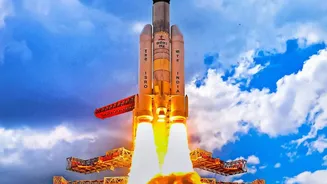
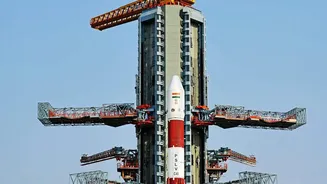
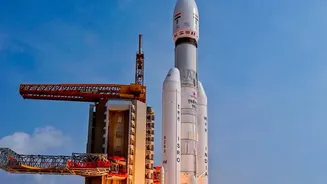
With these qualification tests successfully completed, ISRO continues to march towards the first uncrewed Gaganyaan flight, currently targeted for the latter half of 2026. This mission, designated G1, will be an end-to-end test of the entire system. Instead of astronauts, it will carry a humanoid robot named Vyommitra to simulate the human presence and collect vital data on life support and environmental controls. The successful completion of the G1 mission will pave the way for further test flights and, ultimately, the first crewed mission (H1) targeted for 2027, when India will join the elite club of nations capable of sending their own citizens into space.