






A Volcano Hiding in Plain Sight
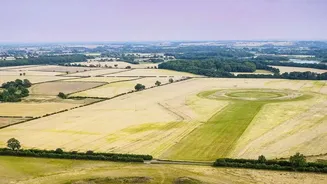
Imagine a volcano, not towering over the landscape, but completely hidden deep underground. That's exactly what geologists have been studying. The remains of this ancient volcanic system are buried beneath The Wash, a large estuary on England's east coast,
and extend into the surrounding counties of Norfolk and Lincolnshire. This isn't a mountain you can climb; its existence has been pieced together through scientific detective work. Geological processes over hundreds of millions of years have completely concealed it under younger layers of rock and sediment. While England isn't typically known for volcanic activity, this discovery reminds us that the land beneath our feet has a dynamic and explosive past. The volcano was active during the Late Ordovician period, a time when the Earth's continents were in very different positions.
The Scientific Detective Story
So, how do you find a volcano that has been buried for nearly half a billion years? The key lies in tiny, resilient minerals and magnetic anomalies. Scientists from the British Geological Survey and the University of Oslo revisited rock samples that were collected from boreholes decades ago, some drilled as far as 65 kilometres apart. Inside these rock cores, they found microscopic zircon crystals, each smaller than the width of a human hair. Zircon is a gift to geologists because it forms inside molten magma and contains trace amounts of uranium. As uranium slowly decays into lead at a known rate, these crystals act as perfect geological clocks. By analysing the isotopes, researchers could precisely date when the crystals—and thus the volcano—formed.
The 'Latest Update': Solving a European Mystery
The latest research provides a major breakthrough, linking this English volcano to a huge layer of volcanic ash found across northern Europe, known as the Kinnekulle tephra. This mysterious ash deposit is found in Norway, Sweden, the Baltic region, Belarus, and Poland, and its source had puzzled geologists for decades. The new analysis, published in the Geological Society of America Bulletin, dated the zircon crystals from the English boreholes to approximately 454.4 million years ago. This age is a near-perfect match for the age of the Kinnekulle ash layer found in Scandinavia. At that time, England and Scandinavia were separated by a body of water called the Tornquist Sea. The evidence strongly suggests that a massive, explosive eruption from this English volcano blasted hundreds of cubic kilometres of ash and rock high into the stratosphere, allowing the plume to travel across the sea and settle over what is now Europe.
A Journey to the Ordovician World
To truly appreciate this discovery, we have to travel back 454 million years. The world of the Ordovician period was vastly different from ours. Most of what would become North America and parts of Europe were located in the southern tropics, straddling the equator. The land that is now England was part of a microcontinent called Avalonia, which was drifting northward. This period saw an intense diversification of marine life, though the land itself was largely barren, with only the most primitive plants beginning to appear. A belt of active volcanoes, similar to the modern-day Pacific Ring of Fire, stretched across this part of the world, and the newly identified volcano was a major part of that system. Its eruptions were incredibly powerful, with some researchers suggesting they had the force of thousands of hydrogen bombs.
Why This Ancient Volcano Matters Today
While this volcano is long extinct and poses no threat, studying it provides invaluable information. It helps geologists reconstruct the ancient geography and tectonic plate movements of our planet, offering a clearer picture of how continents have shifted and formed over eons. The term 'supervolcano' has been used in some reports, though scientists are cautious, as it's difficult to calculate the exact volume of the ancient eruption. What is clear is that the eruption was enormous and had a widespread impact. This research is also a testament to modern scientific techniques, which allowed new discoveries to be made from rock samples collected 80 years ago. It shows how geological archives hold secrets that can be unlocked with new technology, constantly refining our understanding of Earth's deep and often violent history.