

Meet the Lion Nebula
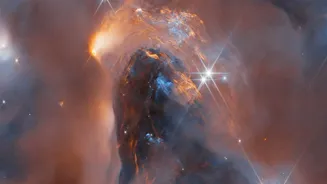
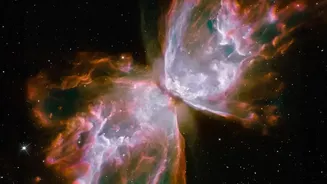
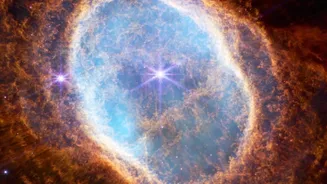
Located thousands of light-years from Earth in the constellation Gemini, NGC 2392 is what astronomers call a planetary nebula. The name is a historical holdover; these objects have nothing to do with planets. Instead, they are the beautiful, glowing shrouds
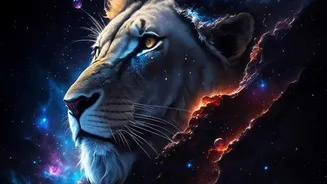
of gas and dust ejected by a dying star similar to our Sun. For years, it was nicknamed the 'Eskimo Nebula' or 'Clown Face Nebula' due to its appearance through older telescopes, though astronomers now favour the name 'Lion Nebula' because its structure resembles a lion's face surrounded by a magnificent mane. Discovered by William Herschel in 1787, this object has fascinated sky-gazers for centuries, but only now are we seeing its true complexity.
The Dying Star's Legacy
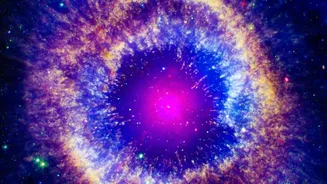
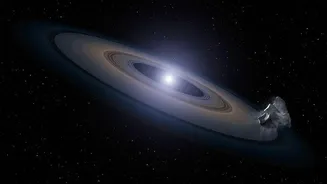
At the heart of the Lion Nebula sits a very hot, dense star known as a white dwarf. This is the remnant core of a star that has run out of its nuclear fuel. In its final phases, the star shed its outer layers into space. Now, the incredibly hot white dwarf, with a surface temperature around 50,000 degrees Celsius, is blasting the surrounding material with intense radiation. This process creates a fascinating interplay of forces. The central star's powerful, fast wind slams into the slower-moving material that was ejected earlier, carving out intricate shells and filaments and making the nebula glow.
What Webb's Infrared Vision Revealed
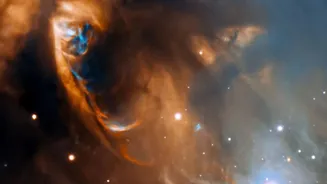
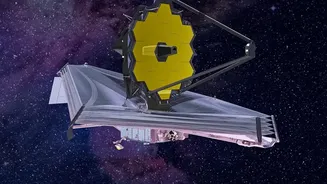
While the Hubble Space Telescope gave us stunning visible-light images of NGC 2392, the James Webb Space Telescope's infrared instruments, NIRCam and MIRI, have peeled back new layers. Infrared light can penetrate through clouds of dust that are opaque to visible light, giving astronomers a clearer picture of the processes at play. The new Webb map highlights the complex distribution of gas and dust. It reveals an inner bubble of ionized gas—the lion's 'face'—that is expanding and destroying dust in its path. But it also shows that some dense clumps of dust have managed to survive this onslaught. These surviving filaments, seen in detail for the first time, form the lion's 'mane'.
Mapping the Cosmic Survivors
The key insight from Webb's mapping is understanding how these different structures coexist. The images show how the surviving dust clumps act as shields, protecting the material lying behind them from the harsh radiation of the central star. These comet-like tufts and strands within the mane are not just beautiful; they are crucial clues to understanding how planetary nebulae get their complex shapes. By precisely mapping the location and temperature of the gas and dust, from the hot, ionized inner bubble to the cooler, clumpy outer mane, scientists can refine their models of stellar evolution. It's a snapshot of a dynamic, violent, and creative process that unfolds over thousands of years.
A Glimpse into Our Sun's Future
Studying NGC 2392 isn't just about a distant, exotic object; it's also a preview of our own solar system's fate. In about five billion years, our Sun, a star of similar mass, will also exhaust its fuel, swell into a red giant, and cast off its outer layers to form its own planetary nebula. The Earth and other planets will be long gone, but the star at the centre of our solar system will become a white dwarf, illuminating the remnants of its former self. By studying the Lion Nebula in such exquisite detail, we are getting a clearer picture of the final, beautiful chapter in the life of Sun-like stars across the universe. It's a cosmic cycle of death and creation, as the elements ejected from these dying stars will eventually be recycled into new stars and planets.