
The Ghosts in the Rings
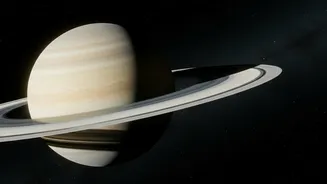
Imagine looking at Saturn’s iconic rings and seeing vast, shadowy smudges stretching across them, like phantom bicycle spokes. These features, some of which can be wider than the diameter of Earth, are not permanent fixtures. They appear, rotate with
the rings for a few hours or days, and then fade away, only to be replaced by new ones. First spotted by NASA's Voyager 2 spacecraft in 1981, the spokes have puzzled planetary scientists ever since. Depending on the viewing angle, they can appear either dark or bright, adding another layer to their enigmatic nature. Their fleeting existence suggests they are not solid structures, but rather a temporary change in the properties of the tiny ice and dust particles that make up the rings.
A Decades-Long Cosmic Mystery
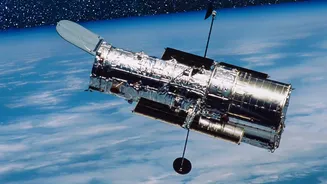
After their initial discovery, the spokes vanished from view for years. Scientists soon realized their appearance was seasonal. Saturn, like Earth, has seasons, but each one lasts about seven Earth years. The spokes seem to appear only around the planet's equinoxes—the time when the rings are tilted edge-on to the Sun. They disappear entirely near the summer and winter solstices. NASA's Cassini spacecraft, which orbited Saturn from 2004 to 2017, got an up-close look during the last equinox in 2009, confirming their seasonal nature. But after Cassini's mission ended, it fell to another sentinel to keep watch: the Hubble Space Telescope.
Hubble's Vigilant Gaze
As Saturn’s northern hemisphere autumnal equinox on May 6, 2025, approached, scientists were ready. As part of the Outer Planet Atmospheres Legacy (OPAL) program, the Hubble Space Telescope began monitoring the planet, waiting for the return of “spoke season.” Sure enough, in 2021, the first faint smudges reappeared. Subsequent images, including a particularly clear one from October 2023, showed the spokes growing more prominent and frequent on both sides of the planet, confirming predictions that their activity would ramp up as the equinox neared. This steady stream of fresh data is providing the crucial clues scientists needed to test their leading theory.
The Electric Ring Theory
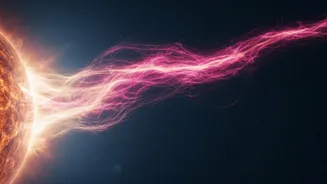
The most widely accepted explanation for the spokes involves a dynamic interplay between Saturn's powerful magnetic field and the solar wind. The theory posits that when Saturn is near its equinox, the solar wind—a stream of charged particles from the Sun—batters the planet's magnetosphere more directly. This interaction can create a temporarily charged environment around the rings. As a result, tiny, dust-sized ice particles can become electrostatically charged and levitate, rising just above the main plane of the rings. This cloud of elevated particles forms a spoke. These features rotate with the planet's magnetic field rather than at the same speed as the ring particles, before losing their charge and falling back into the ring plane, causing the spoke to disappear.
What the New Clues Reveal
The recent observations from Hubble have been a goldmine. The fresh images confirm that spoke activity is indeed seasonal and peaks around the equinox, just as the magnetic field theory predicts. By tracking the spokes' formation, movement, and dissipation over the last few years, scientists have been able to build a much clearer picture of their life cycle. The consistent, long-term data from the OPAL program is helping researchers refine their models of Saturn's magnetosphere and its interaction with the rings. While the spokes were once a complete anomaly, they are now becoming a valuable tool for understanding the complex, invisible forces at play in the Saturnian system.