




A Titan's Sudden Departure
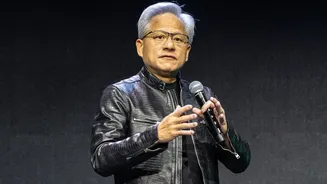
On November 12, 2026, Nvidia announced that Jensen Huang had resigned as President, CEO, and board member, effective immediately. The departure followed a tumultuous period for the company, sparked by reports of Huang's extramarital relationships, including
one with an executive at a major customer and another with an Nvidia employee who reported to him, which raised corporate governance concerns. The board appointed Colette Kress, the company’s long-serving Chief Financial Officer, as interim CEO. The news caused Nvidia's shares to drop significantly, wiping billions off its market value and highlighting how closely the company's identity was tied to its leather-jacket-clad founder. For 33 years, Huang was not just the CEO; he was Nvidia's chief product visionary and strategist, building it into a multi-trillion dollar behemoth at the heart of the AI revolution.
The Roadmap Is the Strategy
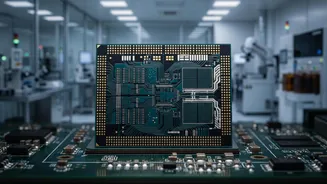
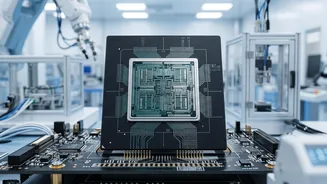
In the wake of the crisis, interim CEO Colette Kress and the board have moved to reassure stakeholders that the company's operational plans remain unchanged. In a statement, Kress committed to building on the foundation Huang created, emphasizing that the focus remains on executing the company's AI roadmap. That roadmap is arguably Nvidia's strongest asset. The company has shifted to an aggressive annual cadence for its data centre platforms to outpace competitors. Following the current Blackwell architecture, the next generation, codenamed 'Vera Rubin', is slated for the second half of 2026, with 'Rubin Ultra' in 2027 and 'Feynman' in 2028. Each new generation promises multiples of performance improvement, designed to handle the exponentially growing demands of AI model training and inference.
More Than Just Chips
Nvidia’s resilience is rooted in a strategy that extends far beyond silicon. For over a decade, the company has cultivated a deep competitive moat with its CUDA software platform. CUDA is the software layer that allows developers to unlock the parallel processing power of Nvidia's GPUs for a wide range of applications, especially AI. With an ecosystem of millions of developers, countless libraries, and deep integration into every major AI framework, switching from Nvidia to a competitor is a costly and complex engineering challenge. This 'full stack' approach, combining hardware, networking (through its Mellanox acquisition), systems like the DGX, and the all-important software, makes Nvidia an infrastructure provider, not just a chipmaker. The company sells entire 'AI factories', not just components.
Navigating the Succession Storm
The immediate challenge is navigating the leadership transition. Huang famously resisted formal succession planning, once stating he did not believe in it. This left the company without a designated heir apparent, forcing the board to launch an external search for a permanent CEO. While Kress has the board's full confidence, her first earnings call as interim CEO was a crucial test to calm market nerves. The company must prove that its institutional strengths and deeply embedded culture of innovation can weather the departure of its singular leader. Observers note that when visionary founders leave, execution-focused successors can sometimes stifle the chaotic creativity that drove initial success. However, the board's message is one of continuity, pledging that customer commitments and product development will proceed without interruption.
The Competitive Landscape Looms
The leadership turmoil comes at a time of increasing competition. Major customers like Google, Amazon, and Microsoft are developing their own custom AI chips to reduce their dependence on Nvidia. Meanwhile, traditional rival AMD is making inroads, securing significant deals with major AI players like OpenAI. Nvidia's strategy to stay ahead involves its rapid innovation cycle and broadening its platform to be indispensable even to those using competing processors. Initiatives like NVLink Fusion allow customers to integrate their own custom chips into Nvidia's architecture, a pragmatic move to ensure Nvidia hardware remains part of the equation. The company's future now rests on its ability to execute this complex strategy without the founder who architected it.