







The Social Media Superstar in Your Home
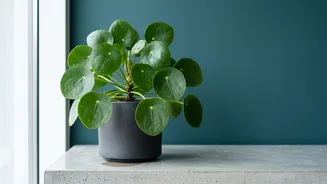
You’ve likely seen it gracing minimalist shelves on Instagram or passed along as a ‘friendship plant’ cutting. The Pilea peperomioides, commonly known as the Chinese Money Plant, Pancake Plant, or UFO Plant, has become a global sensation in indoor gardening.
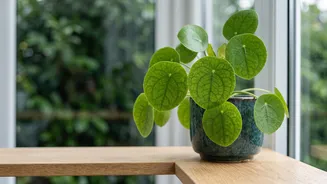
Native to the Yunnan province of China, this evergreen perennial is celebrated for its unique, circular leaves that sit atop long stems, giving it a playful and modern aesthetic. Its journey from the mountains of China to homes worldwide is a story of amateur gardeners and enthusiasts sharing cuttings long before it was formally classified by Western botanists. This simple, easy-to-care-for plant is not just a decorative item; it's a living example of nature's hidden genius.
A Pattern of Natural Perfection
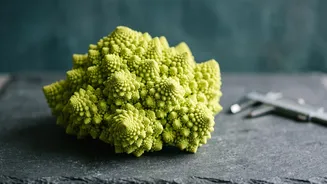
Look closely at any healthy Pilea. Its leaves don’t just sprout randomly. There's a clear order, an elegant arrangement that scientists call phyllotaxis—the study of leaf arrangements on a plant stem. In many plants, this results in mesmerising spirals that often follow the famous Fibonacci sequence, where each number is the sum of the two preceding ones (1, 2, 3, 5, 8...). This mathematical blueprint is also seen in sunflowers, pinecones, and artichokes. While the Pilea's leaf arrangement is a part of this broader phenomenon, recent studies have uncovered an even more specific pattern within its individual leaves, turning this common houseplant into a subject of advanced geometric study.
The Algorithm Without a Brain
So, how does a plant, with no central nervous system, create such intricate designs? The answer lies in a slow, elegant dance of chemical signals. The current consensus points to a plant hormone called auxin. Auxin is a growth regulator that plays a crucial role in almost every aspect of a plant's life. In the case of leaf patterns, auxin acts as an inhibitor. An existing leaf or a developing leaf bud releases auxin, which sends a signal to the surrounding tissue saying, "don't grow here." This creates an inhibitory field, forcing the next leaf to sprout at a specific distance and angle away, a spot where the auxin signal is weakest. This process repeats itself, creating a perfectly spaced spiral that ensures each leaf gets its share of sunlight. It is, in essence, a distributed computational algorithm run by nature.
Voronoi Diagrams: From City Planning to Leaves
Recent research has revealed another layer of mathematical beauty in the Chinese Money Plant's leaves. Scientists discovered that the network of veins on the leaf surface forms a pattern remarkably similar to a Voronoi diagram. A Voronoi diagram is a geometric pattern used to divide a space into regions. Imagine mapping school districts in a city: each school is a central point, and the diagram draws boundaries ensuring every house is in the district of the closest school. On the Pilea leaf, tiny pores called hydathodes act as these central points. Researchers believe that waves of auxin radiate from each pore; where these waves collide, a vein forms. This creates an efficient network for transporting water and nutrients, proving that the pattern is not just for looks—it’s a solution to a complex logistical problem.
Beauty, Survival, and Your Windowsill
This algorithmic elegance isn't just a mathematical curiosity; it's a key to survival. The spiral arrangement of leaves (phyllotaxis) is nature's way of optimising sun exposure, ensuring that new leaves don't block the light from older ones. The vein patterns, meanwhile, create the most efficient plumbing system possible. For those wanting to bring this piece of natural wonder home, the Chinese Money Plant is delightfully low-maintenance. It thrives in bright, indirect light and prefers its soil to dry out slightly between waterings. It's non-toxic to pets and children, making it a perfect addition to any home. Propagating it is also easy, as it readily produces small 'pups' or offshoots that can be repotted and shared, living up to its nickname as the 'friendship plant'.