


Meet Our Cosmic Neighbour
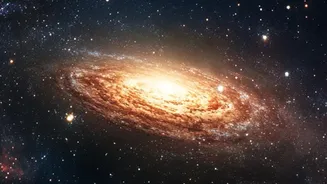
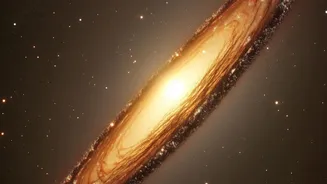
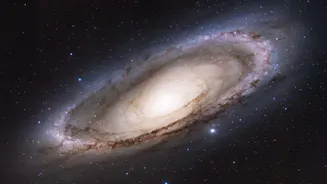
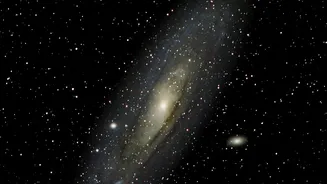
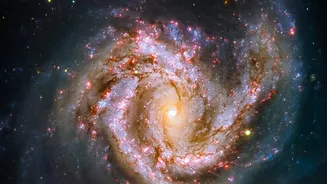
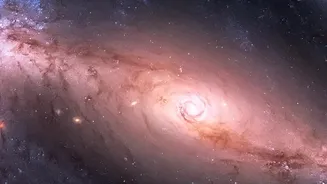
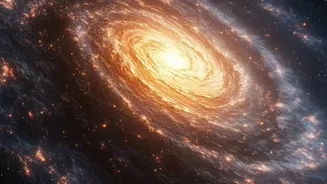
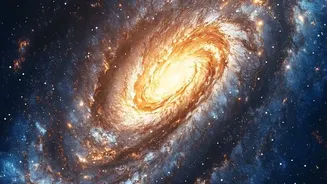
Just 2.5 million light-years away—a stone's throw in cosmic terms—the Andromeda galaxy is the closest major spiral galaxy to our own. Visible to the naked eye as a faint, fuzzy patch in the night sky, it is a magnificent structure containing an estimated
one trillion stars, far more than the Milky Way's own population. Its proximity and size make it the perfect laboratory for astronomers to study galactic evolution. By observing Andromeda, we can learn about the processes that shape galaxies over billions of years, effectively watching a story unfold on a grand scale and gathering clues about our own galaxy's past and future.
A Galactic Star Census
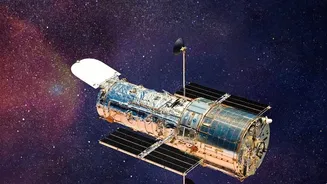
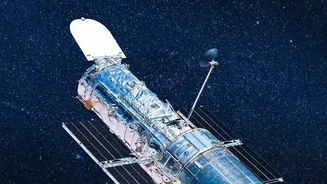
Using the incredible power of NASA's Hubble Space Telescope, astronomers conducted a massive celestial survey, mapping two-thirds of Andromeda's sprawling disk. The project meticulously analyzed the light from approximately 200 million individual stars, treating them as a 'fossil record' of the galaxy's history. Young, hot, massive stars burn with a brilliant blue light but have short lifespans. In contrast, older, cooler, and less massive stars glow with a redder hue and live for much longer. By mapping the colours of its stars, scientists were able to create a detailed history of Andromeda’s star-birthing activity.
The Slowing Factories
The findings, published in The Astrophysical Journal, paint a clear picture of a galaxy in transition. About 500 million years ago, Andromeda was churning out new stars at a respectable rate, equivalent to about one new Sun's worth of mass each year. But that activity has been steadily dropping. The study revealed a significant slowdown over the last half-billion years, with a particularly sharp decline in just the last 40 million years. Today, Andromeda's star formation rate has plummeted to about one-fifth of what it was, signalling that its most productive era is now in the rearview mirror. Much of this decline is concentrated in a prominent ring of gas and dust located about 32,000 light-years from the galaxy's centre, which was once a hotbed of stellar nurseries.
Why Is This Happening?
The immediate assumption might be that Andromeda is simply running out of the raw materials—the vast clouds of gas and dust—needed to create new stars. However, the research suggests this isn't the case. Instead, the galaxy appears to be naturally winding down after a much more energetic period. Previous research indicates that Andromeda experienced a massive burst of star formation about two billion years ago, likely triggered by a merger or close encounter with another, smaller galaxy. In the words of the study's lead author, the galaxy is like a marathon runner that needs to 'take a breather' after a period of intense exertion. Another potential culprit is M32, one of Andromeda's small satellite galaxies. Researchers noted a dip in star formation in an area that M32 may have passed through, hinting that its gravitational influence could be disrupting stellar nurseries.
A Preview of Our Own Future
Andromeda’s slowing metabolism isn’t just a distant curiosity; it’s a preview of the life cycle of large spiral galaxies like our own. All galaxies have a finite supply of fuel for star formation, and as they age, their stellar nurseries inevitably grow quiet. By studying Andromeda's transition toward a more quiescent state, we gain a valuable window into the long-term evolution of the Milky Way. This story has a dramatic final act: Andromeda and the Milky Way are on a collision course, destined to merge in about 4.5 billion years to form a single, giant elliptical galaxy, which has been nicknamed 'Milkdromeda'. Understanding Andromeda's current state helps us model what our cosmic neighbourhood will look like in the distant future.