
A Cosmic Scream for Help
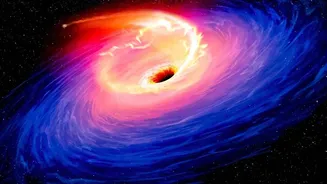
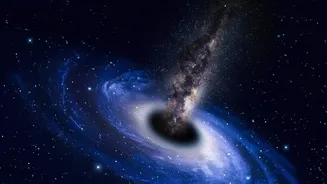
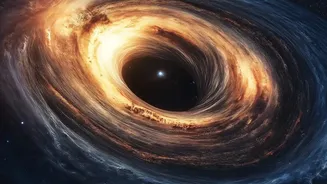
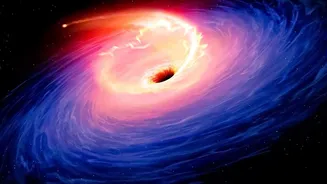
Across the universe, stars are constantly being devoured by black holes in cataclysmic events known as Tidal Disruption Events, or TDEs. When a star gets too close, the black hole's gravitational pull is stronger on the near side of the star than the far
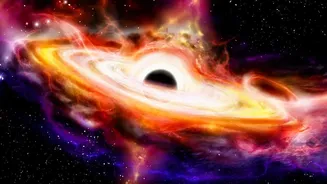
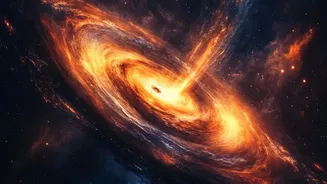
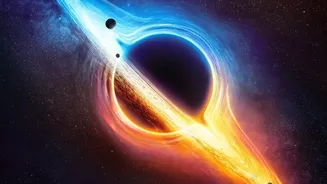
side. This difference in force, the tidal force, stretches the star vertically while squashing it horizontally. This process, nicknamed 'spaghettification', rips the star into a long stream of gas. Some of this stellar material is flung back into space, but the rest forms a blazing hot disc of matter that swirls around the black hole before being consumed. This disc shines incredibly brightly, sometimes outshining entire galaxies, creating a flare of light that telescopes on Earth can detect. For astronomers, these flashes are crucial, as they illuminate the otherwise invisible black holes and allow them to study these enigmatic objects.
The Strange Case of the Off-Centre Flare
For years, astronomers have hunted for TDEs at the hearts of galaxies. That’s because the biggest black holes, known as supermassive black holes, are known to reside at the centre of nearly every large galaxy, including our own Milky Way. So, when a brilliant flare was detected far from the centre of its host galaxy, it presented a cosmic puzzle. One such event, located in a galaxy 750 million light-years away, occurred more than 30,000 light-years from the galactic core. This was one of the most distant off-centre TDEs ever confirmed, proving that massive black holes can lurk in the quiet suburbs of galaxies. The discovery, initially flagged by automated sky surveys like the Zwicky Transient Facility, was followed up by observatories including NASA's Neil Gehrels Swift Observatory, which helped confirm its unusual nature.
Reading the Signatures of Light
So, how do astronomers 'read' an event happening millions of light-years away? The key is analysing the light across different wavelengths, from X-rays to ultraviolet and optical light. By tracking how the brightness of the flare changes over time—a chart known as a light curve—scientists can piece together the story. In a typical TDE, the light rises to a peak over about a month and then slowly fades over several months or even years. For the off-centre TDE, observations with Swift's telescopes measured the glowing stellar gas reaching scorching temperatures. At its peak, the event blazed with the intensity of 10 billion suns. The specific spectrum of the light, including which elements are present and how fast they are moving, helps astronomers confirm that they are witnessing a star being torn apart and not another cosmic event, like a supernova.
A Missing-Link Black Hole
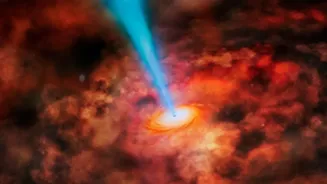
The off-centre location strongly suggested that the culprit wasn't a central supermassive black hole. Instead, scientists believe they have found evidence of an intermediate-mass black hole (IMBH). These objects are the cosmic 'missing link', with masses between 100 and 1,000,000 times that of our sun—bigger than black holes born from single stars but smaller than the supermassive giants in galactic centres. Finding them has been incredibly difficult because they are less active and don't sit in an obvious location. One theory for this wandering black hole is that it was once the core of a smaller galaxy that merged with the larger one. During the chaotic gravitational dance of the merger, the lighter black hole could have been kicked out into the galactic suburbs. Other discoveries, like a repeating TDE named Swift J0230, also point to smaller black holes, as the event's duration often scales with the black hole's mass.