






The Engine Room of Our Planet
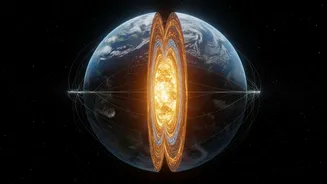
Earth is not a solid ball of rock. Deep inside, past the crust and the thick mantle, lies the core. It’s a two-part system: a solid inner core made mostly of iron and nickel, surrounded by a liquid outer core of the same materials. This outer core is a superheated,
turbulent ocean of metal, constantly in motion. The movement of this electrically conducting fluid acts like a planetary-scale dynamo, generating Earth's magnetic field. This field is crucial for life, acting as an invisible shield that deflects harmful charged particles streaming from the Sun. Without it, solar radiation would strip away our atmosphere and make the surface uninhabitable. For a long time, this deep engine room was considered inaccessible and its large-scale currents were thought to change only gradually over immense timescales.
Listening From High Above
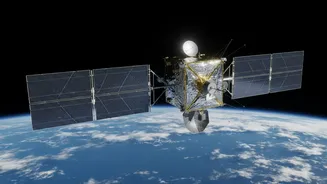
Since we can't send a probe to the core, scientists have to get creative. They use indirect methods, and one of the most powerful is listening from space. The European Space Agency's (ESA) Swarm mission, a trio of identical satellites launched in 2013, is designed for this exact purpose. These satellites are equipped with highly sensitive magnetometers that measure Earth's magnetic field with incredible precision. By flying in coordinated orbits, the satellites can distinguish the magnetic signals originating from the core from the magnetic noise created by the crust, oceans, and atmosphere. Any change in the flow of the molten core leaves a subtle but detectable fingerprint on the magnetic field above. By tracking these changes over years, scientists can reconstruct what the liquid iron is doing thousands of kilometres below.
A Sudden and Unexpected Reversal
For decades, observations suggested that the core's fluid was generally flowing in a westward direction. But by analysing data from Swarm and other satellites, scientists uncovered a dramatic shift. Around 2010, a massive river of molten iron deep beneath the Pacific Ocean, which had been flowing weakly westward, suddenly reversed course and began moving strongly to the east. This wasn't a wobble; it was a significant and rapid change in a broad region of the outer core, challenging the long-held assumption that its circulation was relatively stable. The reasons for this abrupt reversal are still a mystery to scientists, who are now trying to determine its cause and significance.
Is This Cause for Alarm?
A 'core-flow reversal' might sound alarming, but these deep-Earth processes pose no direct danger to people or the climate. However, they are fundamental to understanding how our planet works. The magnetic field is not static; it evolves as the core flow changes, affecting everything from navigation systems to the operation of satellites. Scientists are now debating what this reversal signifies. Is it a short-lived fluctuation, part of a longer, repeating natural cycle, or the beginning of a new, stable pattern of circulation?. Interestingly, recent data suggests that this strong eastward flow has already started to weaken since 2020, lending weight to the theory that it might be a temporary oscillation rather than a permanent change.
Putting It All in Context
This discovery highlights just how dynamic the Earth's interior is. The flow reversal in the outer core seems to coincide with other observed changes deeper within the planet, such as a slowing in the rotation of the solid inner core that also occurred around 2010. Some researchers hypothesise that these events are connected, suggesting a complex dance between the different layers of our planet, from the inner core to the mantle. This challenges the view of the core as a neatly separated system and suggests more interaction between Earth's deepest layers than previously thought. Continued monitoring by missions like Swarm will be essential to track how these flows evolve and to piece together the full picture of the powerful, hidden forces that shape our world.