





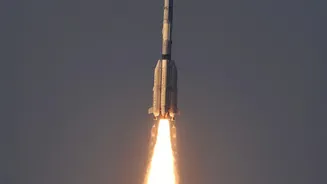
The Workhorse Rocket Gets Stronger
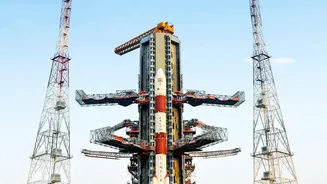
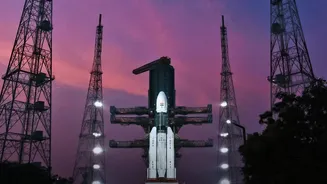
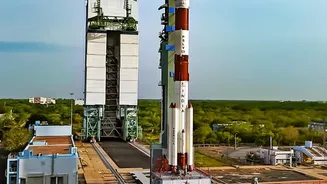
The hero of this mission is the Geosynchronous Satellite Launch Vehicle (GSLV), specifically the GSLV-F17. This recent flight was the GSLV’s 19th mission, demonstrating its growing reliability and solidifying its role as a key asset for India's space
ambitions. Standing 51.7 metres tall, it’s a powerful three-stage rocket designed to lift heavy payloads into high orbits. Its most critical component is the indigenously developed cryogenic upper stage, which uses super-cooled liquid hydrogen and liquid oxygen as propellants. Mastering this complex technology was a huge leap for India, allowing ISRO to launch heavier satellites without foreign assistance. With this mission, the GSLV carried its heaviest payload to date: the 2,367 kg EOS-05 satellite. This success showcases the vehicle's significantly enhanced capacity, a remarkable improvement from its first flight which carried a payload of just 1,536 kg.
An Unblinking Eye in the Sky
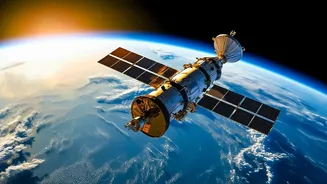
The precious cargo on this flight was EOS-05, an advanced Earth observation satellite. But this isn't just any satellite; it is India's first dedicated imaging satellite designed to operate from a geosynchronous orbit. Think of it as a permanent national watchtower in space. Its primary goal is to provide near real-time imagery of the Indian subcontinent and its surrounding regions. The satellite, also known as GISAT-1A, can capture an image of the entire country every 30 minutes and can be tasked to focus on a specific area of interest for a new image every five minutes. This rapid revisit capability is crucial for a wide range of applications, from civilian to strategic. The data will be invaluable for monitoring agricultural patterns, tracking forest health, and managing vital water resources.
The Magic of a 36,000-Kilometre Orbit
What makes EOS-05 a true game-changer is its destination: a geostationary orbit (GEO) approximately 36,000 kilometres above the Earth’s equator. Most other Indian Earth observation satellites operate in Low Earth Orbit (LEO), just a few hundred kilometres up. While LEO satellites can provide very high-resolution images, they are constantly circling the globe at high speed, meaning they only pass over a specific location at certain intervals. A satellite in GEO, however, travels at the same speed as the Earth's rotation. From the ground, this makes it appear to hang stationary over the same geographical area, allowing for continuous, uninterrupted monitoring. The GSLV-F17 first placed EOS-05 into a temporary Geosynchronous Transfer Orbit (GTO); from there, the satellite will use its own onboard engines to perform a series of manoeuvres over several days to reach its final high-altitude post.
A Boost for Disaster Management and Security
The continuous watch offered by EOS-05 has profound and practical implications for the country. For disaster management, it is a revolutionary tool. The satellite can provide rapid, repeated updates on fast-moving natural disasters like cyclones, floods, and forest fires, giving authorities a vital window to issue warnings and coordinate response efforts. Beyond its civilian uses, the satellite significantly enhances India’s strategic capabilities. Having a persistent eye in the sky that monitors the nation’s borders and vast maritime zones provides an invaluable stream of data for security and defence agencies. This constant surveillance helps in monitoring any developments and ensuring national security with a level of persistence that was not previously possible from space.