






A Gateway Reaching Its Limits
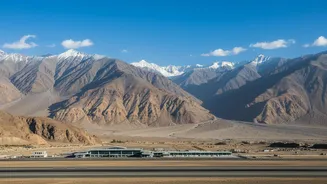
For years, travellers to Leh have known the challenges of its airport. Situated at 10,682 feet, it is one of the world's highest commercial airfields, but its modest size has long been a point of friction. The existing terminal, designed for a much smaller
volume of traffic, has been struggling under the pressure of Ladakh's tourism boom, leading to crowded check-in halls and long waits for baggage, especially during peak season. Currently, the airport handles around 1.19 million passengers annually with about 18 flights per day, a number that has already been increased to meet demand. However, with strong afternoon winds often limiting operations to the morning, the need for a larger, more efficient facility has become critical.
Inside the State-of-the-Art New Terminal
The new terminal building, constructed by the Airports Authority of India (AAI) at a cost of approximately ₹640 crore, is set to revolutionise the passenger experience. It is designed to handle a peak capacity of 2,000 passengers per hour—1,000 arrivals and 1,000 departures simultaneously. This will be facilitated by 20 check-in counters and a modern inline baggage handling system, drastically cutting down on queues. The new facility will also feature two arrival carousels, 15 lifts, and 12 escalators, ensuring smooth passenger flow across its three levels. The goal is to accommodate up to 3.5 million passengers annually, nearly tripling the current traffic.
Boosting Capacity and Connectivity
The expansion goes beyond just the terminal building. After the new terminal becomes operational, the old building will be demolished to make way for an expanded apron with four additional aircraft bays and three aerobridges. This will increase the total number of parking bays to six, allowing the airport to handle up to 54 flights daily—a threefold increase from its current capacity. This dramatic rise in operational capacity will enable more flights from major cities, giving travellers greater flexibility and potentially making airfares more competitive. It is a key step in positioning Ladakh as a more convenient and accessible destination for tourists year-round.
A Landmark in Sustainable Design
Perhaps the most innovative feature of the new terminal is its commitment to sustainability. It is set to become India's first airport powered by a combination of geothermal and solar energy. Given Ladakh's harsh winters, where temperatures can plummet drastically, heating a large terminal is a major energy challenge. The project incorporates a large-scale geothermal heating system to maintain a comfortable temperature inside the building, a first for any airport in the country. This, combined with a 700 kWp rooftop solar power system, will significantly reduce the airport's carbon footprint, setting a new benchmark for infrastructure in ecologically sensitive zones.
Timeline and Strategic Importance
Construction on the new terminal began in 2019, with the foundation stone laid by Prime Minister Narendra Modi. Despite delays caused by the pandemic and the region's challenging climate, which limits the construction window to about six months a year, the project has made significant progress. As of mid-2026, officials reported that over 80% of the physical construction was complete, with a target opening around July or August 2026. This development is not just about tourism; it holds immense strategic importance. Enhancing air connectivity to this critical Himalayan region bolsters India's logistical capabilities and supports overall regional development and security.