


A Famous Star in Our Cosmic Neighbourhood
The story of this new world begins with its parent star, Beta Pictoris. Located a relatively close 63 light-years from Earth, it's one of the most studied stars in our galaxy. It is a young, bright star, only about 23 million years old, which is practically
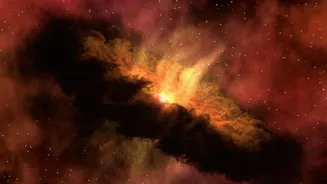
an infant compared to our 4.6-billion-year-old Sun. This youth is precisely what makes it so fascinating. The Beta Pictoris system is surrounded by a vast, glowing disk of dust and debris—the leftover raw material from which planets are made. Observing it is like looking at a snapshot of a planetary system in its turbulent teenage years, offering a rare glimpse into the chaotic processes of planet formation.
A Family of Giants
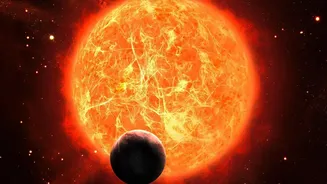
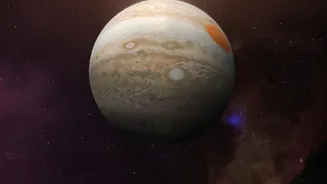
Beta Pictoris was already known to host two massive planets, named Beta Pictoris b and Beta Pictoris c. The first, Beta Pictoris b, was one of the very first exoplanets ever to be directly photographed, a landmark achievement in astronomy. Its sibling, Beta Pictoris c, was later found orbiting closer to the star. The surprise arrival of a third planet, Beta Pictoris d, makes this system exceptionally rare; it is only the second system ever where astronomers have directly imaged three planets. While the other two planets are each roughly ten times the mass of Jupiter, Beta Pictoris d clocks in at about 2.4 times Jupiter's mass. This makes it the smallest of the three giants, yet still a behemoth by any measure.
A Planet Playing Hide-and-Seek
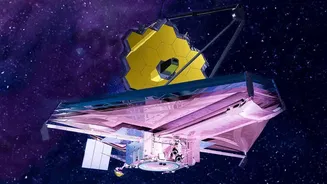
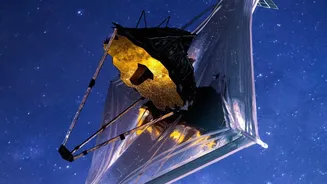
So, if this system is so closely watched, how did a planet more than twice the size of Jupiter remain hidden for so long? The answer lies in the very debris disk that makes the system so interesting. This dense cloud of dust acts like a cosmic fog, scattering the star's light and making it incredibly difficult to spot faint objects nearby. The planet was discovered serendipitously by two independent teams using different powerful telescopes: NASA’s James Webb Space Telescope (JWST) and the European Southern Observatory's Very Large Telescope (VLT). One team wasn't even looking for a new planet. They were studying the atmosphere of Beta Pictoris b when a strange signal appeared in their data. Instead of being found as a simple dot of light, Beta Pictoris d was revealed through the unique chemical signature of its atmosphere, which contains methane, carbon monoxide, and water. In a remarkable piece of astronomical detective work, scientists realised this faint signal had been present, but overlooked, in archived images for over a decade.
Why This Discovery Matters
The discovery of Beta Pictoris d is more than just adding another exoplanet to the catalogue. It validates a new method of planet-hunting. By looking for the specific chemical fingerprints of a planet's atmosphere, astronomers can now find worlds hidden in plain sight, even within bright and messy debris disks. Furthermore, the existence and position of this new planet help solve a long-standing mystery. Its mass and wide orbit, which would place it somewhere between Uranus and Neptune in our solar system, are just right to explain the specific warped shape of the inner edge of the Beta Pictoris debris disk. The planet's gravity is effectively sculpting the disk around it. Systems with multiple, well-characterised planets are like laboratories that allow scientists to test theories of planet formation. The three giants of Beta Pictoris provide a perfect opportunity to study how different planets form and evolve within the same cosmic environment.