




Our Galaxy's Puzzlingly Slow Halo
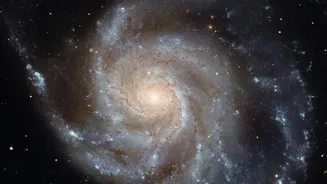
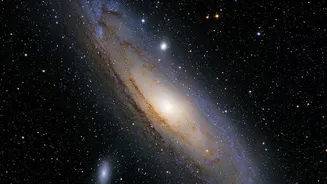
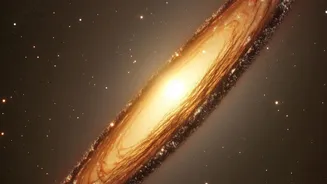
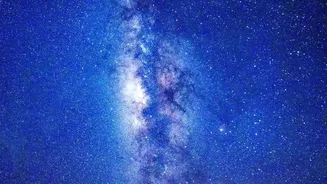
Imagine the Milky Way as a spinning frisbee. The flat, spiralling disc is where most of the stars, including our Sun, reside, rotating at a brisk 220 kilometres per second. Surrounding this disc is a vast, sparse sphere of ancient stars called the stellar
halo. For years, astronomers were baffled by a key detail from ESA's Gaia mission: this halo barely rotates at all, clocking in at a sluggish 10 to 20 kilometres per second. It was a major cosmic mystery. Why would one part of the galaxy be racing along while another is practically standing still? It's like finding a still, calm bubble of air right next to a spinning fan. Scientists believed this discrepancy had to be a clue to a dramatic event in our galaxy's distant past.
The Prime Suspect: A Galactic Collision
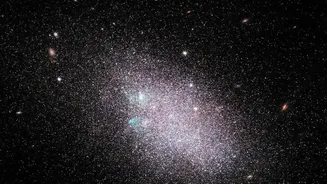
The leading theory points to a cataclysmic event that happened between 8 and 11 billion years ago: a head-on collision with another, smaller galaxy. This invading galaxy, nicknamed the Gaia-Sausage-Enceladus (GSE), was massive in its own right, and it didn't merge quietly. The collision was so violent that it completely reshaped the young Milky Way, scattering billions of the intruder's stars into what would become our modern stellar halo. This event has long been considered the most significant merger in our galaxy's history. The idea is that the stars from this cannibalized galaxy retained their own distinct orbital properties, creating the slow-moving halo we see today.
Flipping the Entire Galaxy
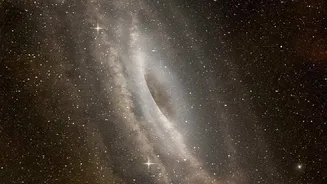
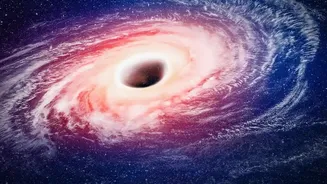
The slow halo was a big clue, but it didn't explain everything. To test the merger theory, researchers at Durham University ran powerful supercomputer simulations of how galaxies like ours evolve. Their findings, presented at the 2026 National Astronomy Meeting, were stunning. In the simulations, galaxies that ended up with slow-moving haloes almost always had two things in common: they experienced a major head-on collision, and their entire disc subsequently flipped by more than 90 degrees. This doesn't mean the galaxy rigidly tipped over like a dinner plate. Instead, over a period of 150 million to two billion years, the immense gravitational forces from the merger gradually torqued and reoriented the entire plane of rotation. The galaxy effectively turned on its side.
Rewriting Cosmic History
If this disc-flip scenario is confirmed, it fundamentally changes our understanding of the Milky Way's life story. It suggests a far more dynamic and chaotic youth than previously imagined. Even our own Sun's path through the cosmos would have been completely different before this flip. This idea is supported by other independent research, which found that the Milky Way's outer dark matter halo seems to be oriented almost perpendicularly to the stellar disc we see today. This misalignment is a strong hint that the inner disc and the outer halo remember two different orientations, with the disc having been tilted long after the halo was in place. It paints a picture of our galaxy as a composite structure, pieced together by violent events that left scars we can still detect billions of years later.