





Defining the Core Beyond the Six-Pack
Before comparing these two disciplines, it’s crucial to understand what the 'core' really is. It’s not just the rectus abdominis, or the 'six-pack' muscles, visible at the front. The core is a three-dimensional group of muscles that wraps around your
entire torso. This includes the deep transverse abdominis, which acts like a natural corset to stabilize your spine and pelvis. It also includes the obliques on your sides, which handle rotation and side-bending, and the muscles of the lower back. A strong core is the foundation of balance, posture, and the efficient transfer of power through the body.
Skating: A Demand for Dynamic, Reactive Strength
Whether on ice or on wheels, skating is an exercise in managing instability. Every push, glide, and turn requires your core to work overtime. The primary demand is for dynamic stability—the ability to keep your torso controlled and rigid while your limbs are in powerful motion. As you push off with one leg, your abdominal muscles and obliques fire to prevent your pelvis from tilting and your upper body from twisting excessively. This allows for an efficient transfer of energy into forward motion. This constant, reflexive stabilization is a form of isotonic work, where muscles contract and shorten to respond to shifting balance and generate force. Landing a jump in figure skating, for example, requires an intensely braced core to absorb the impact and maintain posture.
Tai Chi: Cultivating Slow, Centered Power
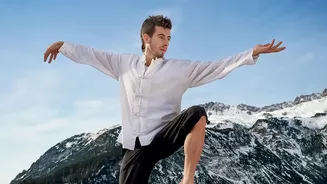
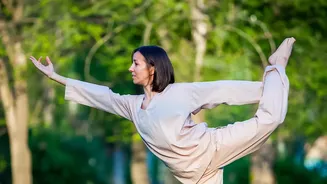
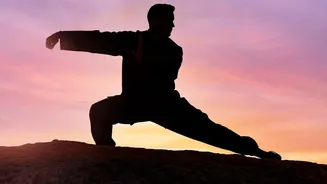
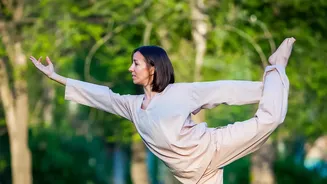
Tai Chi takes a completely different approach to core conditioning. Described by some as a 'sneaky workout', its power comes from slow, deliberate, and controlled movements. In Tai Chi, the focus is on maintaining a stable center of gravity while shifting weight smoothly between postures. This builds incredible isometric strength. Isometric exercises involve muscle contraction without significant movement, like holding a plank. As you hold a Tai Chi posture, your deep core muscles, especially the transverse abdominis and lower back stabilizers, are constantly engaged to keep your spine aligned and your body balanced over your feet. This slow, sustained tension builds deep postural endurance and a profound sense of body awareness.
Stability vs. Propulsion: The Key Contrast
Herein lies the main difference. Skating uses the core to create a stable 'chassis' from which the powerful leg muscles can propel the body forward. The core is constantly reacting to fast, unpredictable movements. The muscle contractions are short, powerful, and designed for agility and power. You are training your core to be a reactive shock absorber and force transmitter. In contrast, Tai Chi uses the core as the very center of all movement. The goal is not propulsion but perfect, unshakeable balance and control. The muscle contractions are sustained and deliberate, training the core for endurance and fine-tuned postural control. Studies have shown that regular Tai Chi practice can significantly improve core strength and balance, comparable to resistance training.
Rotation and Anti-Rotation
Both activities also train the obliques, but in opposing ways. Skating involves generating rotational force for turns and jumps, followed by rapid bracing to control that rotation. This builds powerful, dynamic obliques. Tai Chi, on the other hand, is largely an exercise in 'anti-rotation'. In many postures, the goal is to keep the pelvis and torso perfectly squared forward while the limbs move, forcing the obliques and deeper core muscles to work isometrically to resist twisting. This builds formidable stability that protects the spine from rotational strain in daily life.
Which Is Right for Your Fitness Goals?
Neither activity is definitively 'better' for core strength; they simply build different kinds of strength. If your goal is to develop explosive power, improve your agility, and train your muscles to react quickly, skating is an excellent choice. It provides a significant cardiovascular workout while building a core that can handle dynamic, high-impact forces. If your goal is to improve posture, enhance balance, reduce stress, and build deep foundational stability, Tai Chi is unparalleled. Its gentle, low-impact nature makes it accessible to a wide range of fitness levels while providing a surprisingly deep muscular workout that connects mind and body.