


Our Solar System's Oddball
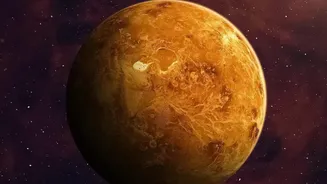
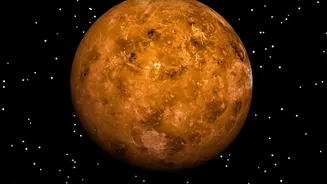
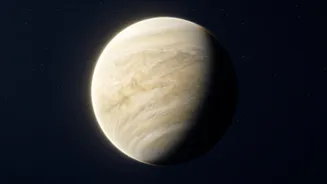
In the family of planets orbiting our Sun, Venus has always been the strange sibling. It’s similar to Earth in size, mass, and composition, leading scientists to label it our twin. Yet the resemblance is only skin-deep. Venus is a hellscape, with surface
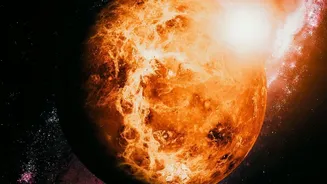
temperatures hot enough to melt lead, a toxic carbon dioxide atmosphere, and clouds of sulfuric acid. Most bizarrely, it spins incredibly slowly and in the opposite direction of most other planets. A day on Venus (243 Earth days) is longer than its year (225 Earth days). Adding to the list of oddities is its solitude. While Earth has its constant companion and even Mars has two small moons, Venus travels alone. Scientists have long debated why. Was it just unlucky, never suffering the kind of giant impact that formed Earth’s moon? Or was a primordial moon blasted away by a later cosmic collision? Recent research offers a more dramatic and intimate explanation.
The Theory of a Doomed Moon
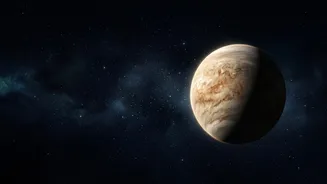
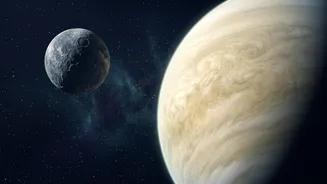
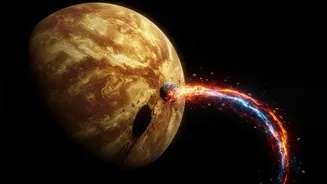
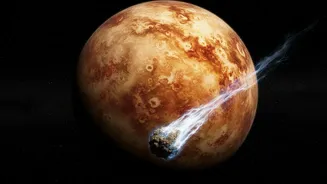
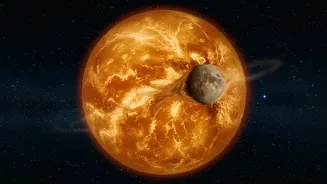
According to new computer simulations from researchers at the University of California, Riverside, Venus may be moonless because it's a planetary cannibal. The study proposes that if Venus ever had a moon, its own physics would have doomed the satellite to a fiery end. The key lies in tidal forces—the same gravitational interactions that cause tides on Earth. Here, the energy from our planet's relatively fast spin is transferred to the Moon, causing it to slowly drift away from us at a rate of about four centimetres per year. Venus, however, spins at a glacial pace. The simulations, led by astrophysicist Stephen Kane, showed that this slow rotation would have the opposite effect. Instead of pushing a moon away, the planet's gravitational pull would gradually sap the moon's orbital energy, causing it to spiral slowly but inevitably inward.
A Cataclysmic Inward Spiral
The simulations tested a wide range of scenarios, varying the mass of the hypothetical moon and the initial spin rate of Venus. In nearly every case, the outcome was the same: the moon crashed into the planet. According to the models, a more massive moon would have hastened its own demise, as it would have been more effective at slowing Venus's spin, which in turn would accelerate its inward journey. This cataclysmic impact would have been a planet-altering event, transferring enormous energy and momentum to Venus. It could have played a significant role in slowing the planet’s rotation to its current state or even flipping its axis, contributing to its retrograde spin. This new theory suggests Venus's current lonely, slow-spinning state isn't the result of a random external catastrophe but a natural, albeit violent, consequence of its own evolution.
The Hunt for Ancient Evidence
While the simulations are compelling, they don't prove Venus had a moon. For that, scientists need physical evidence—and finding the billion-year-old scars of a planetary collision is a monumental task. This is where the "2026 Story" in the headline comes into play, referring not to a single event but to the dawn of a new golden age of Venus exploration. After decades of relative neglect, a fleet of new missions is preparing to unravel the planet's secrets. NASA is preparing two major missions, VERITAS and DAVINCI. VERITAS, scheduled for launch no earlier than 2031, will orbit the planet and create incredibly detailed 3D global maps of the surface, looking for geological evidence of past processes, including a possible moon-sized impact. The DAVINCI mission, also planned for the early 2030s, will drop a probe through the planet's dense atmosphere, sampling its chemistry for clues about its history and whether it ever hosted oceans. Adding to the international effort, the European Space Agency is developing its EnVision orbiter, and just as importantly for Indian audiences, ISRO is planning its own Venus mission, Shukrayaan-1. Initially planned for an earlier launch, Shukrayaan-1 is now slated for 2028 or later and aims to study the Venusian surface and atmosphere, contributing vital data to this global scientific quest.