








A New Eye on the Sky
SPHEREx, which stands for Spectro-Photometer for the History of the Universe, Epoch of Reionization, and Ices Explorer, is not just another telescope. Launched in March 2025, its mission is to conduct an all-sky survey, creating a comprehensive map of the cosmos
in 102 different colors of near-infrared light. Unlike telescopes such as the James Webb Space Telescope that perform deep-dives on specific targets, SPHEREx is a wide-angle cartographer. Every six months, it scans the entire sky, collecting data on hundreds of millions of galaxies and over 100 million stars within our own Milky Way. This sweeping approach is what makes it uniquely suited to hunting for faint, elusive objects like brown dwarfs. By systematically mapping the sky, it can create a census of these objects on an unprecedented scale.
The Universe's 'Failed Stars'
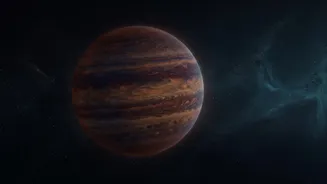
So, what exactly is a brown dwarf? Often called 'failed stars', these celestial bodies occupy a fascinating middle ground. They form from the gravitational collapse of gas and dust clouds, much like stars do. However, they never accumulate enough mass—typically falling in the range of 13 to 80 times the mass of Jupiter—to ignite and sustain the stable hydrogen fusion that powers a true star. For a brief period in their youth, they can fuse a heavier form of hydrogen called deuterium, but once that fuel is spent, they are destined to cool and fade for eternity. Their dim, reddish glow and low temperatures mean they emit most of their light in the infrared spectrum, making them difficult to spot with conventional optical telescopes but perfect targets for an instrument like SPHEREx.
Why Diversity Is the Key
Finding one brown dwarf is interesting, but the true scientific prize lies in finding thousands of them with a wide range of properties. This 'diversity' refers to variations in their mass, age, temperature, and chemical composition. A large and diverse sample allows astronomers to test and refine their models of star formation. Are there more small brown dwarfs than large ones? How does their chemical makeup change in different parts of the galaxy? Studying these free-floating objects, which are untethered to a host star, also gives scientists a clearer view of planetary-mass bodies without the interfering glare of a nearby sun. The atmospheres of brown dwarfs, with their exotic clouds and complex chemistry, can serve as a natural laboratory for understanding the giant planets in our own solar system and beyond.
Spectroscopy: Reading the Rainbow
SPHEREx's key technique is spectroscopy. When light from a celestial object passes through the telescope's instruments, it is split into its component colors, creating a 'spectrum' that acts like a chemical fingerprint. Different molecules in a brown dwarf's atmosphere—such as water, methane, carbon monoxide, and carbon dioxide—absorb light at specific wavelengths, leaving dark lines in the spectrum. By analyzing these patterns across 102 different color bands, scientists can determine the object’s temperature, composition, and other physical properties. SPHEREx’s ability to do this for the entire sky will increase the number of brown dwarfs with complete infrared spectra by a factor of 100, building a massive database that will fuel research for years to come.
More Than Just Brown Dwarfs
While the search for brown dwarfs is a compelling aspect of its mission, SPHEREx has even grander ambitions. Its primary goals are to probe the earliest moments of the universe by studying how galaxies are distributed across the cosmos, a clue to the rapid expansion after the Big Bang known as inflation. It is also designed to investigate the origin of water and organic molecules—the building blocks of life—by studying interstellar ices in stellar nurseries and the disks around young stars where planets form. By taking a cosmic inventory, SPHEREx helps astronomers understand not just individual objects, but the entire ecosystem of the universe, from the initial cosmic blueprint to the formation of stars and planets.