








A Forest's Growing Appetite
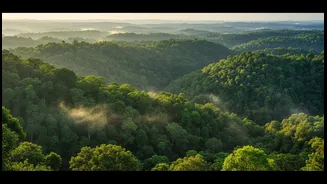
Scientists from the Indian Institute of Tropical Meteorology (IITM), Pune, have projected that the vegetation across the Western Ghats could become one of India's most powerful natural carbon sinks by the year 2100. Their study, published in the 'International
Journal of Climatology', analyzed what is known as Gross Primary Productivity (GPP)—the rate at which plants capture and store carbon dioxide through photosynthesis. Using advanced climate models, the researchers found that India's overall vegetation productivity is set to rise, with the most significant gains expected in the Western Ghats, along with the Himalayas and Northeast India. This suggests these regions will play an increasingly vital role in pulling heat-trapping carbon from the atmosphere, a crucial element in mitigating climate change.
The Science of a Carbon Sink
At its core, this process is about the fundamental power of plant life. Forests act as 'carbon sinks' because trees and other plants absorb carbon dioxide (CO2) during photosynthesis. This carbon is then stored within the plant's biomass—its trunk, branches, leaves, and roots—and also in the surrounding soil. The forests of the Western Ghats already hold a vast reservoir of carbon. The new projections suggest this capacity will grow, primarily driven by two key factors linked to climate change: rising atmospheric CO2, which can boost photosynthesis in a process called 'carbon fertilization', and projected increases in rainfall over many parts of India, which provides the necessary water for plants to thrive.
A Paradoxical Prediction
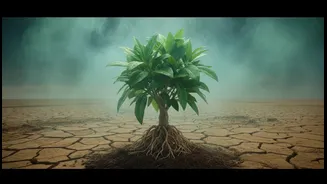
However, the researchers are quick to point out a critical paradox. While the forests may absorb more carbon, this doesn't mean climate change is good for them. The very same factors driving this change also bring immense stress. The IITM study highlights that rising temperatures, especially during unusually warm years, can suppress plant productivity by increasing heat and moisture stress. Another study from IIT Bombay noted that despite increased greening in recent decades, carbon uptake in the Western Ghats has actually seen some decline due to warming. More frequent and intense heatwaves, droughts, and extreme rainfall events can weaken the entire ecosystem, threatening its resilience and the incredible biodiversity it supports.
A Treasure Under Threat
The potential of the Western Ghats to act as a supercharged carbon sink is not guaranteed. It is a possibility that hinges on the health of the ecosystem, which is facing numerous threats. Deforestation, driven by agriculture, plantations, and urban expansion, continues to shrink the forest cover. One analysis showed that intact forests have already declined by 10% and are now mostly confined to protected areas. Without strong conservation policies, simulations predict that evergreen forest cover could shrink dramatically. These land-use changes not only release stored carbon but also disrupt the delicate balance that allows these forests to thrive.
Protecting Our Climate Ally
Realizing this carbon-capture potential requires a dedicated and sustained conservation effort. The findings underscore the urgency of protecting these vital ecosystems not just for their biodiversity, but for their critical role in India's climate action plans. A 'business as usual' scenario leads to a loss of carbon sequestration potential, while a conservation-focused approach can enhance it. This involves robust policies to halt deforestation, promote reforestation with native species, and manage landscapes sustainably. Collaborative efforts involving government agencies, NGOs, and local communities are already underway, but need to be scaled up to ensure this natural climate solution can be secured for the future.