

The Universe's Greatest Mystery
In the late 1990s, astronomers made a shocking discovery: not only is the universe expanding, but it is doing so faster and faster. This acceleration defies our understanding of gravity, which should be slowing the expansion down. To explain this phenomenon,
scientists proposed the existence of a mysterious, invisible force called 'dark energy'. This force is thought to make up roughly 70% of the entire universe, yet we know almost nothing about it. Is it a constant energy of empty space, as Einstein once theorized, or is it a new, evolving field that changes over time? Answering this question is one of the top priorities in all of physics, and it requires a new kind of observatory.
Enter the Roman Space Telescope
Set for launch on August 30, 2026, the Nancy Grace Roman Space Telescope is a next-generation observatory specifically designed to tackle the dark energy puzzle. Named after NASA's first chief of astronomy, Nancy Grace Roman, the telescope has a primary mirror the same size as Hubble's but is equipped with a revolutionary camera. Its 300-megapixel Wide Field Instrument can capture a patch of the sky at least 100 times larger than Hubble can see in a single snapshot, all with similar clarity. This incredible field of view is Roman's superpower. It’s not built to stare at one star for hours; it's a survey machine, designed to map the cosmos faster than ever before.
Creating the Ultimate Cosmic Map
So how will Roman test theories of cosmic expansion? By creating enormous, three-dimensional maps of the universe over cosmic time. It will do this in several ways. One key method is by hunting for thousands of Type Ia supernovae—exploding stars that all have the same intrinsic brightness. By comparing how bright they appear to us versus how bright they actually are, scientists can precisely measure their distance. This allows them to chart the expansion history of the universe. Roman will also map the distribution of billions of galaxies, looking for subtle patterns in their clustering known as Baryon Acoustic Oscillations (BAO). These patterns are like a standard ruler imprinted on the cosmos, providing another way to measure how expansion has evolved.
A Panoramic View of the Cosmos
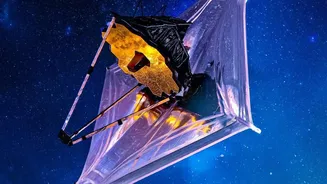
It helps to think of Roman's role in relation to its famous siblings, Hubble and Webb. If the James Webb Space Telescope is a microscope for taking deep, detailed looks at the earliest galaxies, and Hubble is a versatile all-around camera, then Roman is a wide-angle lens for capturing the big picture. Telescopes like Hubble and Webb are essential for studying individual objects in great detail, but their narrow view makes mapping large areas of the sky impractical. Roman will survey the sky up to a thousand times faster than Hubble. By creating these vast catalogues of galaxies and supernovae, Roman will provide a crucial new dataset that complements the deep dives of other telescopes, essentially providing a roadmap for future discoveries.
Rewriting the Textbooks
The data Roman collects will be immense, expected to reach about a terabyte per day. This torrent of information will allow scientists to test the leading theory of cosmology, known as the Lambda-CDM model, with unprecedented precision. This model assumes dark energy is a 'cosmological constant'—an unchanging force. If Roman's measurements confirm this, it will solidify our standard model. However, if the data reveals that the strength of dark energy has changed over time, it could point to new physics beyond our current understanding, possibly even requiring a revision of Einstein's theory of gravity. Either outcome represents a monumental leap in our knowledge about the fundamental nature and ultimate fate of our universe.