



A New Window on Our Star
Perched atop the Haleakalā volcano on Maui, Hawai'i, the Daniel K. Inouye Solar Telescope is a marvel of modern engineering. With a primary mirror stretching four meters (about 13 feet) across, it is the largest solar telescope on Earth, designed for
one purpose: to stare into the heart of our solar system and unlock the secrets of the sun. Its advanced optics allow it to resolve features on the solar surface as small as 20 kilometres across. Recent images have provided the most detailed views ever captured, peeling back the sun's fiery atmosphere and showing a landscape of violent, roiling energy that was previously hidden from view.
Vortices in a Sea of Fire
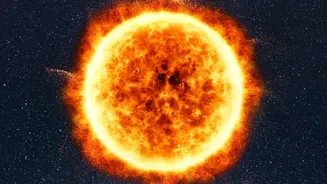
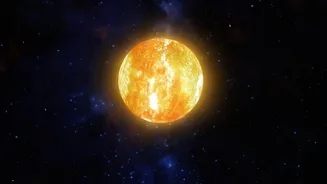
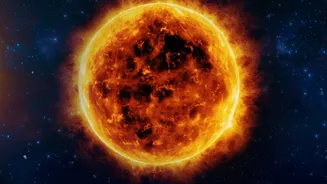
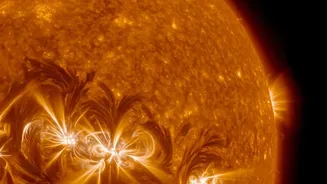
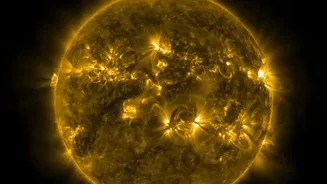
The new images are stunning, showing a patchwork of granular structures, each roughly the size of a large country. These are the tops of convection cells, where hot plasma boils up from the sun's interior, spreads out, cools, and sinks back down in dark lanes. But Inouye's powerful gaze has revealed something new and profound within this familiar pattern: tiny, swirling vortices at the edges of these cells. Scientists have identified these as Kelvin-Helmholtz instabilities, a phenomenon that occurs when fluids moving at different speeds slide past one another, creating a shear that rolls up into spirals, like breaking waves on the ocean. While seen elsewhere in the solar system, this is the first time they have been directly confirmed on the sun's visible surface, or photosphere.
The Science of Solar Turbulence
This turbulence is more than just a pretty picture; it's a fundamental physical process that may hold the key to solving some of the sun's longest-standing mysteries. For decades, scientists have wondered why the sun's outer atmosphere, the corona, is millions of degrees hotter than the surface below it. One leading theory suggests that energy is transferred and released through the complex twisting and snapping of magnetic field lines. These newly discovered vortices, constantly churning at the boundaries of magnetic regions, could be the missing engine that drives this process, continually twisting the magnetic fields and injecting energy into the corona. They represent a previously unseen scale of motion, where mechanical energy from the boiling plasma is converted into magnetic energy.
Why It Matters on Earth
Understanding this solar turbulence has direct implications for our technologically dependent lives. The same magnetic forces that create these tiny swirls on the sun's surface are responsible for much larger and more violent events, such as solar flares and coronal mass ejections (CMEs). When directed at Earth, these eruptions of charged particles constitute 'space weather,' which can damage satellites, disrupt GPS and communication networks, and even cause widespread blackouts by overwhelming power grids. By observing the very roots of this activity, the Inouye Solar Telescope gives scientists the data needed to refine their models of space weather. It's the solar equivalent of improving hurricane forecasts by better understanding the atmospheric conditions that form them, promising a future where we can better predict and prepare for these cosmic storms.