





What Are Black Hole Winds?
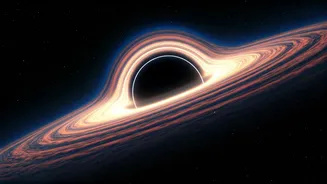
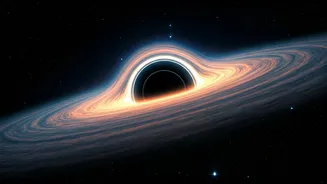
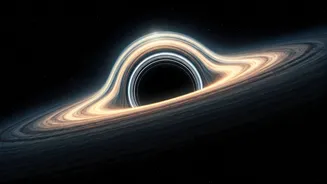
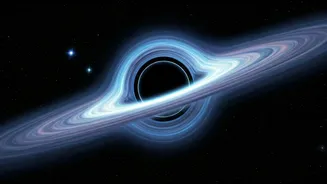
Contrary to their name, black holes don't just swallow everything. As they feed on surrounding gas and dust, the material swirls into a ferociously hot and bright accretion disk before taking the final plunge. The intense radiation and pressure from this
disk can be so powerful that it violently ejects some of the material back into space at incredible speeds. This outflow is what scientists call a "black hole wind." In galaxies with very active, ravenously feeding black holes, these winds can be colossal gales that blast material clear out of the galaxy itself, shaping its very structure and evolution. But our own galaxy's black hole, Sagittarius A (Sgr A), is comparatively quiet, making any potential wind much more like a gentle breeze and incredibly difficult to detect.
A 50-Year Hunt for a Cosmic Breeze
Since Sagittarius A was identified in the 1970s, astronomers have theorized that it must be generating some kind of wind. However, finding direct proof has been a monumental challenge. The galactic center, located 27,000 light-years away, is shrouded in a thick veil of gas and dust, obscuring our view. While previous observations found hints of past, more powerful outbursts far from the black hole, there was no conclusive evidence of a continuous, currently active wind close to Sgr A. This led some to wonder if our galaxy's black hole was a strange outlier. The lack of a detectable wind was a major puzzle, as astronomers believe outflows are a fundamental way black holes interact with their surroundings.
A Breakthrough in the Galactic Haze
Now, a team of astronomers from Northwestern University may have solved the mystery. By using the Atacama Large Millimeter/submillimeter Array (ALMA) in Chile, they spent five years mapping the cold gas around Sgr A. Using new processing techniques, they created the sharpest and most detailed image of the region to date. The result was striking: a cone-shaped cavity, about three light-years long, that was almost completely empty of cold gas. The team reasoned that only a wind flowing from the black hole could have carved out such a feature. This conclusion was strengthened when they overlaid their data with X-ray observations from NASA's Chandra Observatory, which showed hot gas filling the same cone-shaped void. The evidence points to a persistent, though gentle, wind blowing from Sgr A for at least the last 20,000 years.
Why These Gentle Winds Matter
Confirming a wind from our own, relatively placid black hole is a significant breakthrough. It shows that even quiet black holes are not passive bystanders; they are constantly influencing their galactic homes. These winds, even if gentle, play a crucial role in the galactic ecosystem. They can transport energy and matter far from the black hole, regulating the birth of new stars. A wind might compress clouds of gas to trigger star formation, or it could blow the necessary fuel away, quenching it entirely. Understanding this process in our own galaxy provides a vital local laboratory for how supermassive black holes and their host galaxies co-evolve across the universe. This discovery suggests Sgr A is not an oddball, but a normal black hole living out a quiet phase of its life, one that most black holes in the universe are likely in.