


Beyond Supermassive: A New Cosmic Class
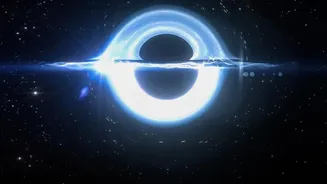
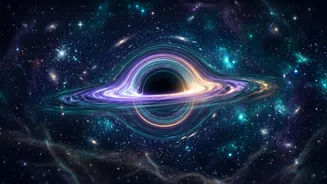
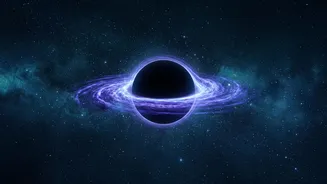
In the cosmic zoo of celestial objects, black holes are already the undisputed heavyweights. We have stellar-mass black holes, typically a few times the mass of our Sun, formed from the collapse of giant stars. Then there are the supermassive black holes (SMBHs)
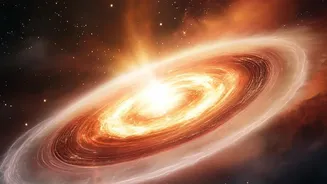
that lurk at the heart of most large galaxies, including our own Milky Way, with masses ranging from millions to billions of solar masses. The largest confirmed black hole, powering a quasar named TON 618, weighs in at a staggering 66 billion times the mass of the Sun. But now, some scientists are asking: what if there is another, even more massive category? Enter the 'stupendously large black hole', or SLAB. This is a hypothetical class of black hole with a mass exceeding 100 billion Suns, and potentially reaching into the trillions.
How Do You Build a Monster?
A black hole of such epic proportions poses a significant problem for astrophysicists: how could it possibly form? Standard black holes grow by accreting, or pulling in, surrounding gas, dust, and stars, or by merging with other black holes. However, there are theoretical limits to how fast a black hole can feed. The intense radiation blasted out by the infalling matter can push away incoming fuel, a process which should cap a black hole's growth at around 50 billion solar masses over the age of the universe. This makes it difficult to explain how a SLAB could form through conventional means. Instead, researchers propose a more ancient and exotic origin story. These giants might be 'primordial black holes' (PBHs), objects hypothesised to have formed not from stars, but from the direct collapse of dense pockets of matter in the chaotic, high-pressure environment of the very early universe, less than a second after the Big Bang.
The Dark Matter Connection
This is where the theory gets even more exciting, potentially solving two cosmic mysteries at once. For decades, astronomers have known that there is more to the universe than meets the eye. Galaxies rotate faster than they should, held together by the gravitational pull of some invisible substance dubbed 'dark matter'. This mysterious material is thought to make up about 85% of the universe's total mass, but its true nature remains unknown. One compelling idea is that dark matter isn't made of an undiscovered particle, but is actually composed of primordial black holes. Unlike black holes formed from stars, PBHs could have formed with a wide range of masses. If these ancient black holes exist in vast numbers across different sizes, they could collectively account for all the missing mass we attribute to dark matter. The stupendously large ones would be the rarest of this family, but their smaller primordial cousins could be lurking unseen all around us.
Hunting for Unseen Giants
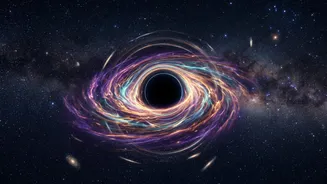
Finding a SLAB is a monumental challenge. By definition, they don't emit light. However, their immense gravity would warp spacetime around them, acting like a cosmic magnifying glass. One detection method involves looking for this gravitational lensing effect, where the light from a distant galaxy is bent and distorted by a massive object in the foreground. Another way to infer their presence would be to study their impact on the Cosmic Microwave Background (CMB), the faint afterglow of the Big Bang. A stupendously large black hole would cast a giant 'shadow' against this ancient light. While no SLABs have been detected to date, recent studies analyzing the CMB have placed new constraints on how many of these giants could exist, suggesting they can't be a major component of dark matter, though their existence isn't ruled out entirely.