




What is Swing-Based Training?
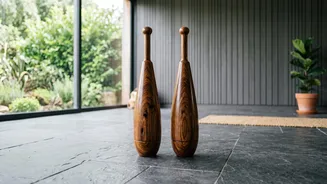
Swing-based training involves using tools with an offset centre of gravity, like kettlebells, steel maces, or clubbells, to perform dynamic, rhythmic movements. Unlike the linear, controlled motions of a bicep curl or bench press, these exercises are
built around momentum and flow. The most well-known example is the kettlebell swing, a powerful, explosive exercise that involves swinging the weight from between your legs up to chest height. This type of training focuses on movement patterns rather than isolating individual muscles, creating a workout that is part strength, part cardio, and entirely dynamic.
Beyond Simple Strength
A standard strength routine is excellent for building muscle and raw power. Lifting heavy weights in controlled planes of motion creates a strong foundation. However, athleticism in the real world is rarely so predictable. Life requires us to move in multiple directions, react to instability, and coordinate our entire body to perform a task, whether it's lifting a heavy box, playing a sport, or catching your balance on an uneven surface. This is where coordination comes in. It’s the ability of your nervous system to make different muscles work together harmoniously to perform a movement smoothly and efficiently. Pure strength alone doesn't guarantee this neurological skill.
How Swings Forge Coordination
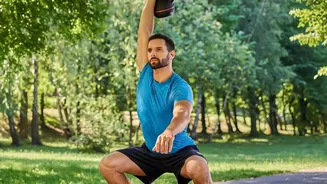
Swing-based movements are a masterclass in coordination for your body. To perform a kettlebell swing or a steel mace 360 correctly, you must generate force from the ground up, transferring it through your core and into your extremities in perfect sequence. This is known as improving the kinetic chain. The dynamic and often rotational nature of these exercises forces your stabiliser muscles—the smaller muscles around your joints and in your core—to work overtime to control the momentum and maintain balance. This constant adjustment teaches your body to anticipate, react, and move as a single, unified system, which directly enhances your overall coordination and body awareness.
A Complement, Not a Replacement
It’s important to see swing-based training not as a replacement for your existing routine, but as a powerful complement. Think of your traditional strength training as building the engine, and swing-based training as fine-tuning the transmission and steering. Kettlebell swings, for example, build explosive power in the posterior chain (glutes, hamstrings, back), which supports heavy lifts like squats and deadlifts. Meanwhile, more complex tools like clubbells and steel maces introduce rotational and anti-rotational challenges that most conventional gym equipment simply can't replicate, filling in the gaps in your functional fitness.
Getting Started with Swing Movements
Integrating swings is simple. You can add them as a dynamic warm-up, a 'finisher' at the end of your workout, or on a dedicated conditioning day. Start light to master the form before increasing the weight.Two-Handed Kettlebell Swing: This is the foundational exercise. Stand with feet shoulder-width apart, hinge at your hips (don't squat), and drive the kettlebell forward using the power of your hips and glutes, not your arms. The goal is an explosive snap of the hips to propel the bell to chest height. This builds timing and power.Steel Mace 360: This movement involves swinging the mace in a circular pattern around your head. It’s excellent for shoulder mobility, grip strength, and learning to control momentum in a rotational plane. The offset weight constantly challenges your core to stay tight and resist the pull, enhancing stability and coordination.