




A Breakthrough Discovery in the Stars
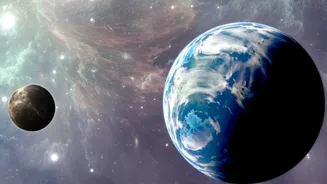
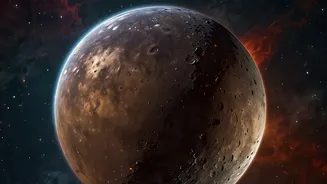
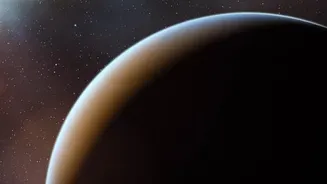
In a landmark moment for astronomy, scientists have detected an atmosphere on a rocky, Earth-like exoplanet located in the habitable zone of its star. The planet, known as LHS 1140 b, is about 39 light-years away and has long been a subject of interest
since its discovery in 2017. This new finding is a major milestone because an atmosphere is considered essential for a planet to support life as we know it. For years, astronomers wondered if rocky planets in other star systems could even hold onto their atmospheres. Now, they have proof that at least one can. This confirmation moves the search for extraterrestrial life from a question of possibility to a more focused investigation of this intriguing new world.
The View from the Atacama Desert
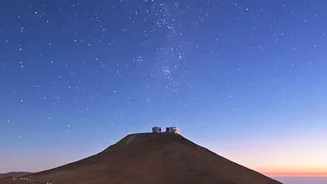
The discovery was made using the Magellan Clay telescope at the celebrated Las Campanas Observatory in Chile. This region is a paradise for astronomers due to its high altitude, dry air, and minimal light pollution, offering some of the clearest views of the night sky on Earth. The team of scientists used a powerful instrument on the telescope called the WINERED spectrograph. By observing LHS 1140 b as it passed in front of its host star—an event known as a transit—they were able to study the starlight filtering through the planet's uppermost atmosphere. This technique allowed them to detect the chemical signature of helium, which was seen escaping from the planet's atmosphere.
What Makes This Finding a 'First'?
While astronomers have detected atmospheres on many exoplanets before, those have almost exclusively been on large, gaseous giants similar to Jupiter or Neptune. Finding an atmosphere on a smaller, rocky planet like Earth has been a much greater challenge. What makes the LHS 1140 b discovery so significant is that it's the first time an atmosphere has been confirmed on a terrestrial-type planet that also orbits within its star's habitable zone. This is the region where conditions might be just right for liquid water to exist on the planet's surface. The presence of a substantial atmosphere, estimated to be over 3 billion years old, dramatically increases the chances that this distant world could be habitable.
Rewriting Our Understanding of Planetary Systems
The existence of this atmosphere challenges some previous assumptions. The host star, LHS 1140, is a red dwarf. These types of stars are known for being active, especially in their youth, often blasting their nearby planets with intense radiation that can strip atmospheres away. The fact that LHS 1140 b has managed to retain its atmosphere for billions of years suggests that some rocky worlds are more resilient than previously thought. The data showed that while helium is escaping, it must also be constantly replenished from a source on the planet, possibly volcanic activity. This points to a dynamic and geologically active world, providing a crucial piece of the puzzle in understanding how planets form and evolve. The team also observed a second planet in the system, LHS 1140 c, but found no evidence of an atmosphere there, highlighting how differently two worlds in the same system can develop.
The Next Chapter in the Search for Life
This discovery opens up a new frontier for research. LHS 1140 b has immediately become a prime target for follow-up observations by the world's most powerful telescopes, including the James Webb Space Telescope. Scientists are eager to learn more about the atmosphere's composition beyond helium. They will search for heavier gases like water vapor, methane, and carbon dioxide, which are trapped closer to the planet's surface and are key biosignatures—indicators of potential life. Answering these questions will help determine if LHS 1140 b is not just habitable in theory, but a world that could actually harbor living organisms. This finding transforms the planet from a point of light into a tangible place with its own weather and geology, bringing us one step closer to answering one of humanity's oldest questions: Are we alone in the universe?