









The Cloud Has a Physical Address
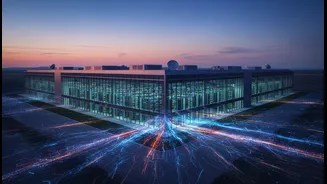
Every time you stream a movie, join a video call, or use an AI chatbot, you are accessing a data centre. These are not abstract entities but colossal industrial buildings, often windowless and sprawling over millions of square feet. They house thousands
of computer servers, networking gear, and cooling systems that form the physical backbone of the internet. The boom in our digital lives, supercharged by the demands of artificial intelligence, has triggered an unprecedented surge in data centre construction across the globe, including a significant expansion in India. India’s data centre capacity is projected to more than double between 2023 and 2026, driven by digitisation and data localisation policies. While we generate 20% of the world's data, India currently holds a small fraction of global data centre capacity, signalling a massive construction wave is underway.
An Unquenchable Thirst for Power
Data centres require a constant, massive supply of electricity to run servers and, crucially, to keep them from overheating. Cooling systems alone can account for over 40% of a facility's total electricity usage. Globally, data centres already consume 1-2% of the world's electricity, and this demand is accelerating. Projections from Gartner show worldwide data centre electricity consumption is expected to jump by 26% in 2026 alone. The rise of AI is a primary driver; AI-optimised servers are projected to account for nearly a third of data centre power consumption in 2026, and will likely surpass conventional servers by 2027. A single modern AI data centre can use as much electricity as 100,000 homes. This immense energy draw puts a strain on local power grids and often relies on fossil fuels, which directly contributes to greenhouse gas emissions. Some centres also use large diesel generators for backup power, which emit significant air pollutants.
The Hidden Water Footprint
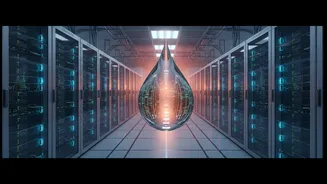
Less discussed than energy use, but equally concerning, is the vast amount of water consumed by data centres. Many facilities use water-based cooling systems, where water is evaporated to dissipate the immense heat generated by servers. A large hyperscale data centre can consume up to five million gallons of water per day, comparable to the water usage of a small city of up to 50,000 people. This places a direct strain on local water supplies, which is a critical issue in water-stressed regions. The water consumption is both direct (for cooling) and indirect (the water used to generate the electricity powering the centre). In 2023, Google reported its data centres used over 5 billion gallons of water. With the AI boom, this demand is set to skyrocket, posing serious questions about resource allocation, especially when many centres draw from the same potable drinking water supplies used by local communities.
The Carbon Cost of Concrete and Steel
The environmental impact begins long before a data centre is switched on. The construction phase itself carries a heavy carbon footprint, often referred to as "embodied carbon." These are fortress-like structures built with enormous quantities of concrete and steel—two of the most carbon-intensive materials to produce. Manufacturing cement, the key ingredient in concrete, is a major source of global CO2 emissions. The sheer scale of these projects means the embodied carbon is substantial. This initial environmental cost is locked in before the first server is even installed, adding a significant, often overlooked, layer to the industry's total climate impact. As the industry expands, with some estimates suggesting India's data centre real estate footprint will hit 7.8 million square feet by the end of 2024, the cumulative impact of construction materials becomes a critical concern.
A Search for Greener Solutions
The industry is not blind to these challenges, and the race for sustainable solutions is underway. In India and globally, there is a push to power data centres with renewable energy; Amazon, for instance, is adding wind and solar projects across the country. Innovations in cooling, such as direct-to-chip or liquid immersion cooling, promise to dramatically reduce energy and water use compared to traditional air-cooling methods. Companies are also exploring more sustainable building materials, like hybrid timber and steel constructions, to lower the embodied carbon footprint. Furthermore, there is a growing movement to locate data centres in regions with cooler climates or access to clean energy and to use recycled or non-potable water for cooling to preserve precious drinking water resources.