



A Solar System in Crisis
For most of the 20th century, the solar system felt complete. After Clyde Tombaugh discovered Pluto in 1930, our cosmic neighbourhood had a neat roster of nine planets. But starting in the 1990s, powerful new telescopes began revealing that Pluto wasn't
alone in the icy depths beyond Neptune. Astronomers found a vast swarm of similar icy bodies, a region we now call the Kuiper Belt. The real crisis began in 2005 with the discovery of Eris, an object that appeared to be even larger than Pluto. This put the scientific community in a bind. If Pluto was a planet, then Eris surely had to be the tenth planet. And what about the other large, round objects being found? Astronomers faced the prospect of a solar system with dozens of planets, or they had to finally create a formal definition for the word.
The Three Rules That Changed Everything
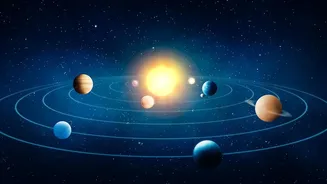
In August 2006, members of the International Astronomical Union (IAU) gathered in Prague to settle the debate. After much discussion, they voted on a resolution that established, for the first time, a scientific definition of a planet. According to the IAU, a celestial body must meet three specific criteria to earn the title: it must orbit the Sun; it must have enough mass for its own gravity to pull it into a nearly round shape (a state known as hydrostatic equilibrium); and it must have "cleared the neighbourhood" around its orbit. This third rule, which refers to a planet being the gravitationally dominant object in its orbital zone, would become the critical point of contention and the one that redrew our map of the solar system.
Why Pluto Didn't Make the Cut
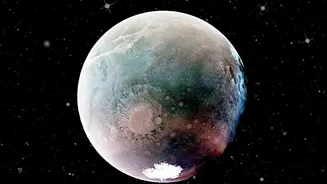
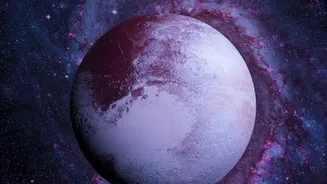
Pluto successfully meets the first two IAU criteria: it orbits the Sun and it is spherical. However, it fails on the third count. Pluto's orbit is located within the crowded Kuiper Belt, where it shares its path with countless other icy objects. It is not gravitationally dominant in its region, unlike Earth or Jupiter, which have swept their orbital paths clean of similar-sized bodies over billions of years. Because it hadn't cleared its neighbourhood, the IAU reclassified Pluto into a new category: a "dwarf planet." It joined Eris, Ceres (the largest object in the asteroid belt), and later, Makemake and Haumea as the first official members of this new class of worlds.
An Enduring Controversy
The decision was, and remains, highly controversial. Many planetary scientists, including Alan Stern, the principal investigator of the New Horizons mission, strongly disagree with the IAU's definition. They argue that the "clearing the neighbourhood" requirement is flawed, as its meaning can change depending on a planet's distance from its star. Under this rule, they contend, an Earth-sized planet in Pluto's distant orbit might not qualify as a planet either. This group advocates for a geophysical definition: if a world is large enough to be round, it should be considered a planet, regardless of what's in its orbital path. The public outcry was also significant, with many feeling a sentimental attachment to the ninth planet they learned about in school. The debate continues two decades later, with prominent figures occasionally calling for Pluto's status to be reinstated.
Pluto's Vindication as a World
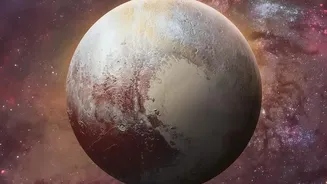
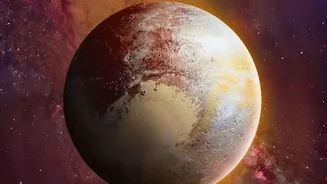
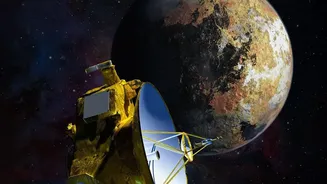
Ironically, just as Pluto was being demoted, NASA's New Horizons spacecraft was en route to visit it. When it arrived in 2015, it revealed a world far more complex and dynamic than anyone had imagined. Instead of a simple, frozen rock, New Horizons found a stunningly diverse landscape of towering water-ice mountains, vast nitrogen glaciers, a thin blue atmosphere, and possible signs of geologic activity. It has a complex system of five moons, with its largest, Charon, being so big that the two are often considered a binary system. While the probe's findings didn't change Pluto's official classification, they vindicated its importance. The mission proved that even if it isn't a planet by the current definition, Pluto is a fascinating and active world worthy of exploration.