





A Cosmic Accounting Problem
Our understanding of the universe begins with the Big Bang, which produced the lightest elements: primarily hydrogen and helium. The rest of the elements, from the carbon in our bodies to the oxygen we breathe, are forged in the nuclear furnaces of stars.
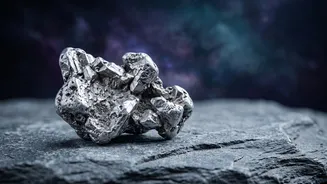
As stars live and die, they fuse lighter elements into heavier ones. But this process has a limit. Stellar fusion can create elements up to iron, which has 26 protons. Making elements heavier than that requires more energy than a typical star can muster during its lifetime. This left a huge gap in our knowledge. Where did the universe get its vast supply of heavier, rarer elements like silver, gold, platinum, and uranium?
The Old Theory: Supernovae
For a long time, the leading theory was that these heavy elements were created during supernovae—the cataclysmic explosions of massive stars. The idea was that the intense pressure and energy of a collapsing star could force atoms to fuse into heavier elements in a matter of seconds. This process, called the rapid neutron-capture process or "r-process," describes an environment so chaotic that atomic nuclei are bombarded with neutrons faster than they can decay, building them up into the heavyweights of the periodic table. While supernovae do create some heavy elements, the theory had its problems. The numbers didn't quite add up; supernovae alone couldn't account for the observed abundance of r-process elements in the cosmos. The universe's gold mine had to be somewhere else.
Enter the Neutron Stars
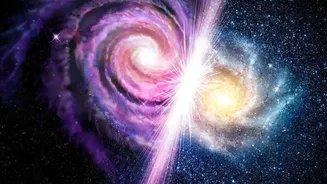
The answer, scientists now know, lies with neutron stars. These are the ultra-dense collapsed cores left behind after a massive star goes supernova. They are among the densest objects in the universe; imagine an object the size of a city that has more mass than our sun. A single teaspoon of neutron star material would weigh billions of tons. Sometimes, two such stars are locked in a binary system, orbiting each other. Over millions of years, they lose energy and spiral closer and closer together, destined for a final, spectacular collision.
A Collision of Cosmic Titans
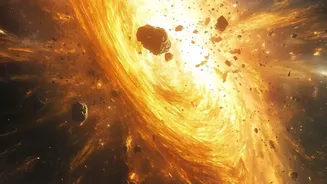
The merger of two neutron stars is an event of unimaginable violence. As they collide, they unleash a flash of light and energy known as a kilonova. This environment is the perfect factory for the r-process. The collision ejects a massive cloud of neutron-rich material, creating the exact conditions of extreme temperature, pressure, and neutron flux needed to forge the heaviest elements in the universe. In this cosmic crucible, huge quantities of gold, platinum, and uranium are created in an instant and flung out into space. A single neutron star merger can produce an amount of gold equivalent to the mass of several Earths.
The Smoking Gun: GW170817
The definitive proof came on August 17, 2017. For the first time, scientists detected gravitational waves—ripples in the fabric of spacetime—from a pair of merging neutron stars. The event, dubbed GW170817, was also seen by dozens of telescopes across the globe and in space, which captured its electromagnetic light. This was a breakthrough for "multi-messenger astronomy." By analysing the light from the kilonova, astronomers could see the distinct spectral fingerprints of heavy elements like strontium being forged in the afterglow, confirming that these mergers are indeed the primary source of the universe's r-process elements. This observation effectively closed a 70-year-old quest for the origin of these materials.