



A Heart That Isn't Frozen Solid
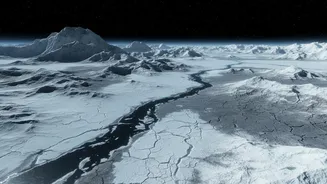
The most stunning feature New Horizons captured was Tombaugh Regio, a bright, heart-shaped region on Pluto's surface. The western lobe of this heart, Sputnik Planitia, is a vast basin filled with frozen nitrogen, larger than Texas and Oklahoma combined.
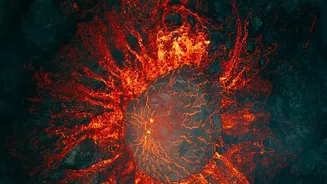
Scientists noticed its surface was almost entirely free of impact craters, a clear sign that the landscape is geologically young and constantly being renewed. The surface is broken into city-sized polygonal cells that look like the patterns in a slowly boiling pot of soup or a cosmic lava lamp. This pattern is caused by a process called solid-state convection, where solid nitrogen, warmed by Pluto’s faint internal heat, slowly rises, cools, and sinks again. It was a revelation: this distant, frozen world was far from dead.
From Solid Churn to Liquid Flow
The churning of solid ice was astonishing enough, but a new analysis of the New Horizons data, published in August 2026, provides evidence for something even more surprising: flowing liquid nitrogen. Researchers studying the northern edges of Sputnik Planitia noticed dark features that look remarkably similar to areas on Earth's glaciers that have been wetted by liquid water. Since Pluto's thin atmosphere makes liquid nitrogen rain impossible, the scientists concluded the liquid must be coming from below. Computer models show that pressure at the base of the kilometers-deep nitrogen glacier could be sufficient to melt the ice, creating pockets of liquid nitrogen. This liquid could then be forced up through cracks and conduits, briefly flowing across the surface before re-freezing, creating the dark patterns seen in the images.
A Blueprint for Icy Worlds
This discovery on Pluto is more than just a local curiosity; it serves as a vital blueprint for understanding other cold, distant bodies. The processes of solid-state convection and subsurface melting of nitrogen are new tools in the planetary science toolkit. For decades, scientists have theorized about 'cryovolcanism'—volcanoes that erupt volatiles like water, ammonia, or nitrogen instead of molten rock—on various icy moons. However, observing the process is incredibly difficult. Pluto provides a natural laboratory where the effects of this activity are laid bare on the surface, without a thick, obscuring lithosphere (or rocky crust) getting in the way. By studying how heat from Pluto's core interacts with its nitrogen ice sheet, scientists can refine their models and know what to look for elsewhere.
Next Stop: Triton and Beyond
The most immediate beneficiary of this newfound knowledge is the study of Triton, Neptune’s largest moon. When Voyager 2 flew by in 1989, it spotted geyser-like plumes erupting from Triton's surface, which scientists have long suspected were driven by nitrogen. Triton and Pluto are often considered planetary twins due to their similar size, composition, and distance from the sun. The evidence of subsurface liquid nitrogen flows on Pluto gives immense weight to the theory that similar, or even more active, processes could be happening on Triton. The mechanisms that melt and transport nitrogen on Pluto could be the very same ones powering Triton's plumes. This insight extends to the entire Kuiper Belt, a vast region of icy objects beyond Neptune. By understanding the geology of Pluto, scientists are now better equipped to interpret faint data from these even more distant worlds, searching for signs of unexpected activity.