




The Prevailing Theory of Stellar Winds
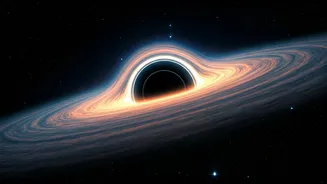
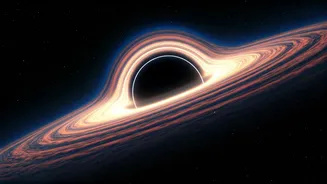
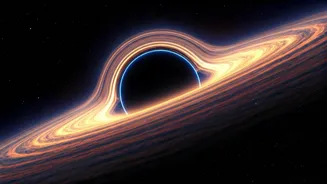
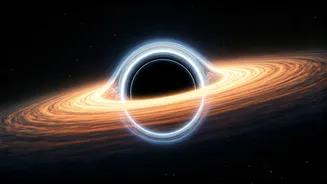
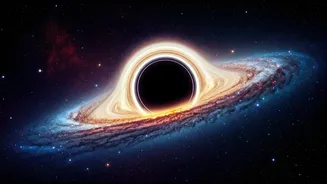
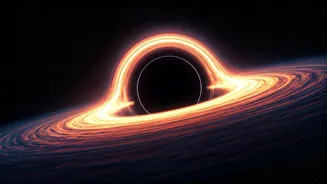
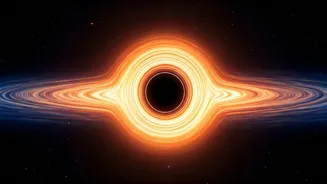
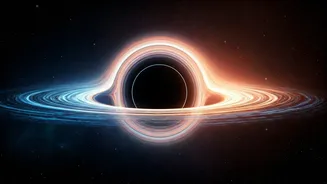
Imagine the centre of the Milky Way, 26,000 light-years away. It’s a chaotic, crowded neighbourhood. At its very core sits Sagittarius A (Sgr A), a black hole with the mass of four million suns. For years, the prevailing theory was that the hot gas swirling
around this behemoth was supplied by 'stellar winds'. These are streams of particles blowing off the surfaces of the massive, young stars that orbit the black hole. This hot gas, captured by Sgr A's immense gravity, was thought to be its primary source of fuel. The logic was simple: the winds from these nearby stars feed the black hole's accretion disk — the swirling collection of matter from which the black hole 'eats'. This model explained why the region is relatively faint; most of the material is ejected before it ever crosses the event horizon, or the point of no return. This process was seen as the main driver of activity in our galactic centre.
A 50-Year Search Reveals a New Picture
Astrophysicists have long predicted that as black holes consume matter, they should also blow their own 'winds' or jets outward. While this has been seen in more active galaxies, finding proof around our relatively quiet Sgr A was a 50-year-long scavenger hunt. Recently, a team of astronomers using the Atacama Large Millimeter/submillimeter Array (ALMA) in Chile and NASA's Chandra X-ray Observatory made a breakthrough. By combining years of highly detailed observations, they created the sharpest-ever map of the cold gas near the black hole. After carefully filtering out the black hole’s own bright glow, a stunning feature appeared: a giant, cone-shaped hole in the cold gas, pointing directly away from Sgr A. This wasn't just an empty space; Chandra data showed this cavity was filled with hot, X-ray-emitting gas.
More Than Just Star Power
This discovery provides the first clear evidence that Sgr A is generating its own powerful, hot wind, which has been blowing for at least 20,000 years. This black hole wind is carving out the cone-shaped cavity by pushing away or heating up the surrounding cold gas. Scientists calculated the energy required to create such a large void and concluded that the winds from nearby stars alone were not powerful enough to do it. This means there is another, more powerful engine at work: the black hole itself. As material spirals into Sgr A, it heats up and generates immense pressure, launching a portion of that matter back out into space. This finding elegantly solves the long-standing mystery of the 'missing' black hole wind at the centre of our own galaxy.
A Cosmic Regulator in Our Backyard
This isn't just a cosmic storm in a teacup; the discovery has profound implications for how our galaxy evolves. This process, known as 'astrophysical feedback', shows how even a relatively quiet black hole actively regulates its environment. By blowing away the raw materials needed to form new stars, Sgr A* acts like a galactic thermostat, controlling the rate of star birth in its vicinity. This finding proves that even dormant black holes play a crucial role in shaping their galaxies. The Milky Way’s centre provides a unique, local laboratory to study this subtle feedback mechanism, which is believed to be the dominant state for most galaxies in the universe. It helps us understand the life cycle of galaxies, including our own, filling a significant gap in our cosmic knowledge.