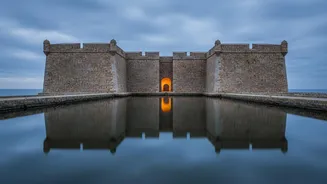









The Initial Conquests
The story of modern European presence in these cities begins in the 15th century, an era of maritime expansion. Portugal, a major sea power, conquered the strategic port of Ceuta in 1415, marking the beginning of its North African expansion. For decades,
Ceuta served as a key Portuguese military and commercial base. Melilla's path was different. It was conquered not by the Portuguese, but by Spain in 1497. The Catholic Monarchs, Ferdinand and Isabella, took the city as part of a broader strategy to secure their influence in the Mediterranean and North Africa following the completion of the Reconquista in Spain.
How Ceuta Became Spanish
For over a century, Ceuta remained a Portuguese possession. This changed due to royal politics in Europe. From 1580 to 1640, Spain and Portugal were united under a single Spanish monarch in what was known as the Iberian Union. During this 60-year period, many Spanish settlers moved to Ceuta, shifting its demographic balance. When Portugal regained its independence in 1640, the city of Ceuta made a pivotal choice: it decided to remain loyal to the Spanish Crown rather than rejoining Portugal. This decision was formally recognized in the Treaty of Lisbon in 1668, when Portugal officially ceded Ceuta to Spain, cementing Spanish sovereignty over the city.
Centuries of Spanish Rule
Spain's argument for sovereignty rests on this long history. Both cities have been under Spanish control for over 500 years, predating the creation of the modern Moroccan state in 1956. Throughout the centuries, Spain defended the cities against numerous sieges and attacks. One of the most notable was the Siege of Ceuta, which lasted from 1694 to 1727 and is considered one of the longest in history. Various treaties between Spain and Moroccan sultans over the years further defined the borders and, from Spain's perspective, repeatedly affirmed its control over the territories. Unlike former colonies, Ceuta and Melilla have never been listed by the United Nations as non-self-governing territories awaiting decolonization.
The Modern Dispute with Morocco
Since gaining its independence from French and Spanish protectorates in 1956, the Kingdom of Morocco has consistently laid claim to Ceuta and Melilla, which it considers to be occupied territories. Despite centuries of Spanish presence, Morocco argues that the enclaves are geographically and historically part of its territory. This claim is a persistent feature of diplomatic relations, with Moroccan officials regularly raising the issue. Spain, however, firmly rejects any negotiation over their sovereignty. The Spanish Constitution of 1978 incorporates the cities as integral parts of the nation. In 1995, they were granted the status of 'autonomous cities', giving them a level of self-governance similar to other regions in mainland Spain.
A European Border in Africa
Today, Ceuta and Melilla represent the only land borders between the European Union and Africa. With Spain's entry into the EU in 1986 and the Schengen Area in 1991, their borders became external frontiers of Europe. This has turned them into focal points for migration, as people from across Africa attempt to reach European soil. The resulting humanitarian and security challenges frequently create tension between Spain and Morocco. Recent events, such as the major migrant surge into Ceuta in July 2026, have highlighted the fragility of the situation and brought the centuries-old sovereignty dispute back into the international spotlight.