


A World of Constant Fire
In the grand theatre of our solar system, few bodies are as dramatic as Io. It is the most volcanically active world known to us, a place peppered with over 400 active volcanoes that constantly repaint its surface with sulphur and molten rock. This tiny
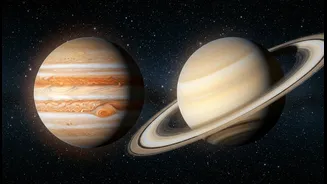
moon, only slightly larger than Earth's, is caught in a relentless gravitational tug-of-war. Its parent planet, the gas giant Jupiter, pulls it one way, while its neighbouring moons, Europa and Ganymede, tug it another. This constant stretching and squeezing generates immense friction and heat inside Io, a process known as tidal heating. This internal furnace is the engine driving its spectacular, non-stop volcanism, with some eruptions blasting plumes hundreds of kilometres into space.
A Groundbreaking New View
For decades, our knowledge of Io's heat came from looking at the very top layer of its surface, mostly through infrared telescopes. This gave us a picture of where volcanoes were erupting, but it was like trying to understand a boiling pot by only looking at the steam. Now, that has changed completely. Scientists with NASA's Juno mission have produced the first-ever subsurface heat map of the moon. Using data collected during two close flybys in late 2023 and early 2024, they have managed to measure the temperature a few metres beneath the crust, offering a direct glimpse into how heat moves from the interior outwards.
How Juno Peered Inside
The key to this breakthrough is an instrument on the Juno spacecraft called the Microwave Radiometer (MWR). Unlike infrared instruments that capture surface heat, the MWR is designed to detect microwave radiation at frequencies that can penetrate solid material. By listening to these faint radio waves, scientists could effectively see through the top layer of Io's crust and measure the temperature gradient below. The data revealed a startling discovery: almost everywhere the instrument looked, the temperature rose significantly just a few feet into the surface, a gradient far too steep to be explained by solar heating alone. It was a clear sign of powerful heat rising from deep within.
What the Heat Map Reveals
The new map shows Io's subsurface is not uniformly hot. Instead, it features distinct hotspots where internal heat is most intense. One massive heat anomaly was detected near a volcanic complex known as Zal Montes Patera, where other Juno instruments had spotted an active lava flow. Another major heat source stretches near the moon's equator. These findings confirm that immense thermal energy is moving up through the upper crust. The data presents two main possibilities for how this happens: either the heat is steadily rising through a conductive crust, or it's being transported by magma flowing closer to the surface than previously thought. The map also shows, surprisingly, that away from these hotspots, much of Io's surface is smooth and made of low-density material.
Solving the Magma Ocean Mystery
For years, a leading theory was that Io’s intense tidal heating maintained a global, subsurface ocean of molten rock. However, more recent data from Juno has challenged this idea, suggesting Io’s interior might be more of a "slushy" mantle—mostly solid rock with pockets of magma—rather than a full-fledged ocean. This new subsurface heat map provides a crucial piece of that puzzle. By showing exactly where and how heat is emerging, it helps scientists refine their models of what's happening inside. It moves the conversation from whether a magma ocean exists to characterising the specific mechanisms that allow heat and lava to reach the surface. This is a fundamental step toward a complete geological model of Io.
A Window into Other Worlds
Understanding Io is about more than just one violent moon. The process of tidal heating is a fundamental force across the cosmos. The same gravitational flexing that powers Io's volcanoes is thought to maintain the liquid water oceans believed to exist beneath the icy shells of its neighbours, Europa and Ganymede—two of the most promising places to search for life beyond Earth. By studying this process in its most extreme form on Io, we learn how heat can keep distant worlds warm and potentially habitable. According to Scott Bolton, Juno's principal investigator, this new technique could even be adapted to study volcanoes on our own planet, potentially offering a new way to see heat signatures below ground.