



A Ghost in the Data
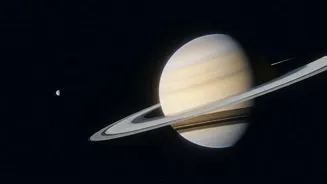
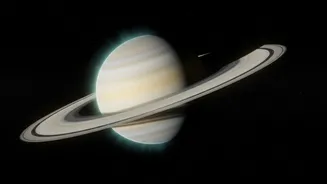
The Cassini mission was a joint venture by NASA, the European Space Agency (ESA), and the Italian Space Agency (ASI) that orbited Saturn for 13 years. Before its fuel ran out, the spacecraft performed a daring series of 22 dives between the planet and its iconic
rings, a region no probe had ever explored. This "Grand Finale" gathered unprecedented data before the mission concluded with a planned, fiery entry into Saturn's atmosphere to avoid contaminating its potentially habitable moons. Though the spacecraft is gone, the treasure trove of data it collected will keep scientists busy for decades, with new discoveries still being unearthed years later.
The Magnetosphere: A Planet's Shield
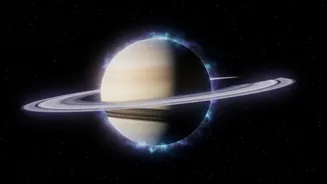
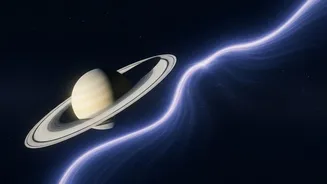
To understand the latest discovery, you first need to know what a magnetosphere is. Think of it as a giant, invisible bubble created by a planet's internal magnetic field. This bubble acts as a shield, deflecting most of the harmful, high-energy particles streaming from the Sun, known as the solar wind. Earth has one, which is why we have spectacular auroras at the poles. But Saturn's magnetosphere is a puzzle. For one, it's enormous, the second largest in the solar system after Jupiter's. More importantly, it was long thought to be oddly symmetrical, with its magnetic axis almost perfectly aligned with its rotational axis, which defies current theories of how planetary magnetic fields are generated.
A Lopsided Shield
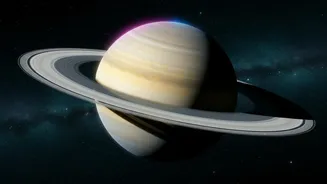
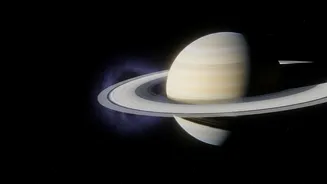
Recent analysis of Cassini data has turned this puzzle on its head, revealing that Saturn's magnetic shield isn't smooth and symmetrical at all. Instead, it's noticeably lopsided. A key feature of a magnetosphere is the "cusp," a funnel-like opening where solar particles can leak into the atmosphere. On Earth, this cusp sits predictably near the pole facing the Sun (at the 12 o'clock position, so to speak). But new findings show that on Saturn, the cusp is consistently dragged far to the side, toward the afternoon (between 1 and 3 o'clock).
The Culprits: Fast Spin and an Icy Moon
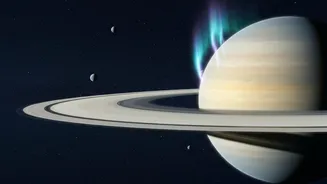
So what's causing this strange distortion? Researchers have pinpointed two main culprits: Saturn's incredibly fast rotation and one of its own moons, Enceladus. Saturn spins on its axis in just under 11 hours. As it whirls, it drags along a thick cloud of plasma—electrically charged gas—that is constantly being supplied by the icy geysers erupting from Enceladus. The moon spews huge quantities of water vapor into space, which becomes ionized and gets caught in the magnetic field. According to the new analysis, the sheer force of Saturn's rapid spin and this heavy plasma soup it drags along is powerful enough to overpower the solar wind's influence, twisting the magnetosphere and shoving the cusp to the side.
Why This Discovery Matters
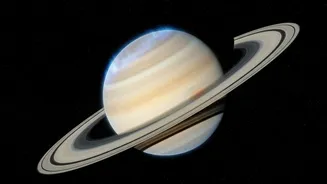
This discovery fundamentally changes our understanding of how giant planets work. It confirms that on fast-spinning gas giants, the planet's own rotation and internal plasma sources can be more important in shaping their space environment than the external pressure from the Sun's solar wind. This is a fundamentally different regime from planets like Earth. Understanding this bizarre, rotation-dominated system not only helps explain things like Saturn's bright auroras but also provides a new model for understanding the thousands of gas giant exoplanets being discovered around other stars. It proves that even from beyond the grave, Cassini is still rewriting the textbooks on planetary science.