
A New Cosmic Enigma
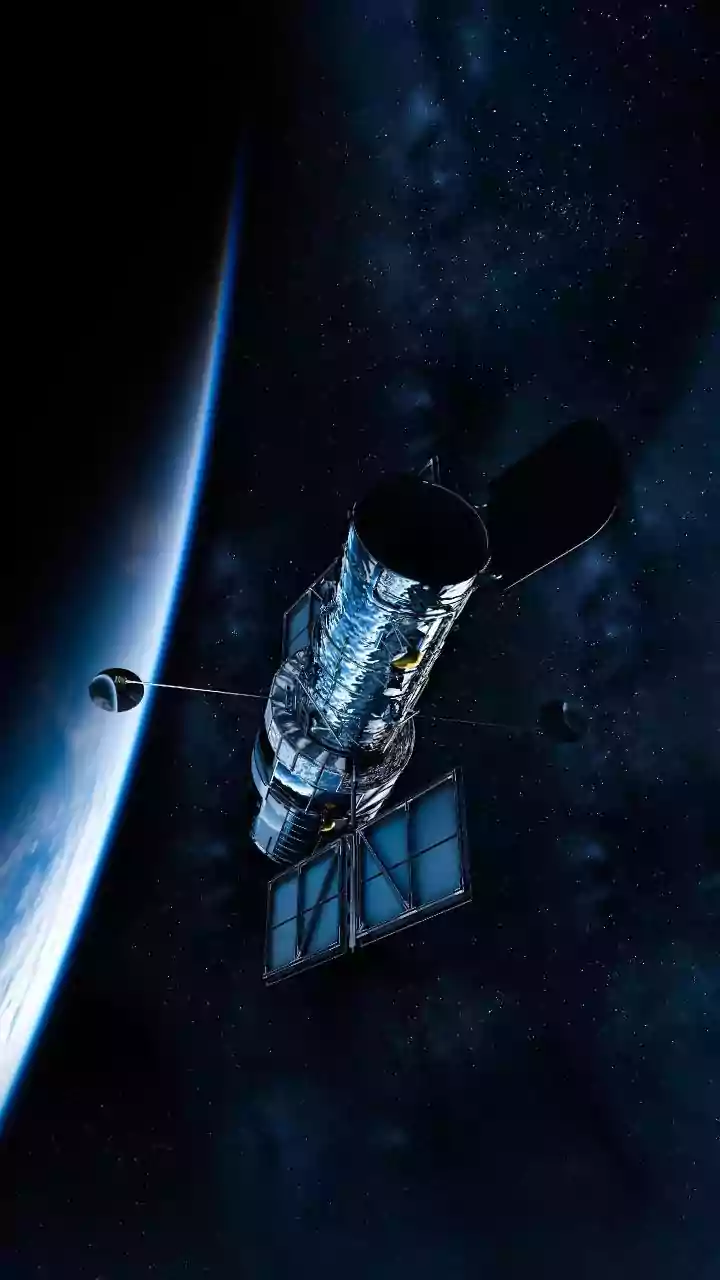
Using the powerful James Webb Space Telescope (JWST), an international team of astronomers identified an unusual object named MoM-BH-1. Located in the constellation Cetus, the light from this object has travelled for over 13 billion years to reach us, giving
us a snapshot of the universe when it was only about 660 million years old. The object was discovered during a survey aptly named "Mirage or Miracle" (MoM), which was designed to find the earliest galaxies. MoM-BH-1 stood out because it was exceptionally bright and red. While redness in space often implies an object is obscured by dust, analysis suggested this wasn't the case. Instead, it appeared to be an extremely bright object shrouded in a thick cocoon of gas. Its brightness was staggering, shining with the energy of 100 billion suns, far beyond what any normal star could produce through nuclear fusion. This led scientists to consider a more exotic explanation.
What Is a Black Hole Star?
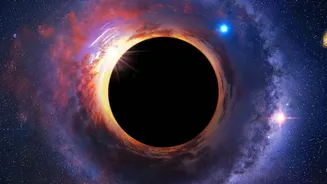
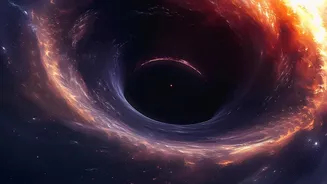
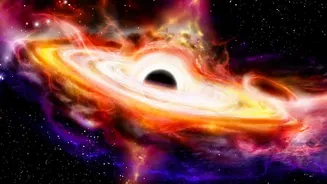
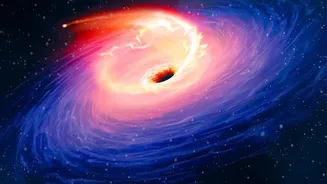
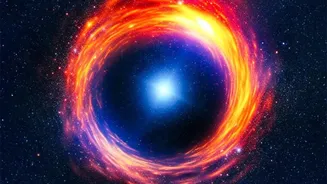
The term 'black hole star' might sound like a contradiction, but it refers to a hypothetical object also known as a 'quasi-star'. Unlike the stars we see today, which are powered by nuclear fusion in their cores, a quasi-star's energy would come from matter falling into a central black hole. The theory suggests that in the very early universe, massive clouds of pristine hydrogen and helium gas could collapse under their own gravity. In some cases, the core of a giant protostar, perhaps a thousand times the mass of our sun, would collapse into a black hole first. However, the vast outer layers of gas would be so massive that they wouldn't be blown away. Instead, they would form a gigantic, star-like envelope around the newly formed black hole. This envelope, roughly the size of our solar system, would glow intensely as the black hole at its heart feeds on the surrounding material, releasing enormous amounts of energy.
The Missing Piece of the Puzzle
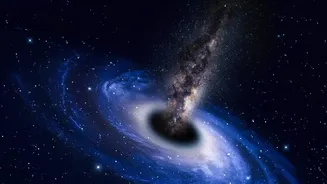
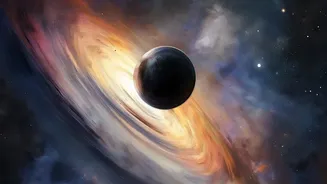
The potential discovery of MoM-BH-1 is so exciting because it could solve a major cosmic mystery: how did supermassive black holes get so big, so fast? Astronomers have observed that nearly every large galaxy, including our own Milky Way, has a supermassive black hole at its centre. The puzzle is that we see these giants, with masses millions or billions of times that of our sun, existing very early in the universe's history—a time when they seemingly shouldn't have had enough time to grow so large. Standard models of black hole growth, where they form from collapsed stars and slowly accrete matter, don't fully account for these early behemoths. Quasi-stars, or black hole stars, provide a potential solution. They act as massive 'seeds,' starting with an already large black hole that can grow incredibly rapidly by consuming its gaseous envelope in a process called super-Eddington accretion. This allows them to quickly become the supermassive black holes we see in the early cosmos.
Solving the 'Little Red Dot' Mystery
MoM-BH-1 is also helping astronomers understand another recent puzzle from the JWST: the appearance of numerous 'little red dots' in deep space imagery. These compact, reddish objects have baffled scientists. The discovery of MoM-BH-1 suggests that many of these little red dots could actually be black hole stars embedded within young host galaxies. What makes MoM-BH-1 special is that it appears to be 'naked'—its light almost completely outshines any potential host galaxy, giving scientists a clear, unobstructed view of the black hole star itself. By studying its unique light signature, astronomers can create a template to better understand the other little red dots, separating the light of the central object from its surrounding galaxy.
Confirmation Awaits
While the evidence is compelling, astronomers are careful to note that MoM-BH-1 is still a candidate black hole star. The 'possible' in the headline is crucial. The initial findings are based on a model that best fits the unusual data, but further observation and analysis are needed for definitive proof. The discovery, however, has provided the strongest evidence yet for this new class of cosmic object. Scientists now have a clear target and a set of characteristics to look for as they continue to scan the early universe. The simultaneous discovery of another similar object, nicknamed 'The Cliff,' further strengthens the case that these are not isolated flukes but represent a new, important phase in cosmic evolution. Future observations with the JWST and other telescopes will be essential to confirm the nature of MoM-BH-1 and to hunt for more of these incredible objects hiding at the dawn of time.