



What Exactly is V2V Communication?
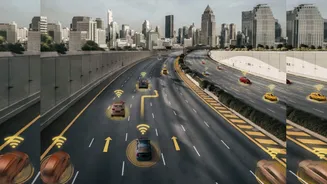
At its core, Vehicle-to-Vehicle (V2V) communication is a wireless technology that allows cars, bikes, buses, and trucks to constantly talk to each other. They automatically broadcast tiny radio signals containing key information—like their speed, location,
direction, and whether they are braking or accelerating. This creates a 360-degree awareness network. Unlike cameras or radar, which can only see what is in their line of sight, V2V works around corners, through traffic, and in bad weather. It can warn a driver about a car that braked suddenly several vehicles ahead or an unseen vehicle approaching a blind intersection, giving the driver or the car's safety systems crucial extra seconds to react.
Why India is Pushing for Talking Cars
The primary motivation is a stark one: road safety. India has one of the highest rates of road accident fatalities in the world. In 2025 alone, the country recorded over 183,000 deaths from road accidents. Many of these are caused by factors V2V is designed to mitigate, such as sudden braking, collisions at intersections, and wrong-way driving. By providing warnings that transcend a driver's field of view, the technology is expected to significantly complement existing Advanced Driver Assistance Systems (ADAS) and create a proactive safety net. The Ministry of Road Transport and Highways (MoRTH) sees this as a crucial step towards intelligent transport systems that can drastically cut down on human error, the leading cause of accidents.
The Government's Roadmap
The government is not leaving this to chance. According to a draft notification from MoRTH, India plans a phased mandatory implementation. The first stage is set for October 1, 2027, from which point any vehicle voluntarily fitted with a V2V system must comply with a new standard, AIS-230. The game-changer is the second stage: from October 1, 2028, it will be mandatory for all newly manufactured two-wheelers, cars, buses, and trucks to be equipped with these compliant V2V systems. This applies to vehicle categories L (two/three-wheelers), M (passenger vehicles), and N (goods vehicles), covering nearly every new vehicle on the road. The proposal is currently in a draft stage, open for public comment before it becomes final.
The Technology and its Hurdles
The technology chosen for India is Cellular Vehicle-to-Everything (C-V2X), which can use both direct short-range communication and existing 4G/5G cellular networks. The Department of Telecommunications has already delicensed the required 5.9 GHz spectrum band for this purpose. However, the path ahead is not without bumps. The biggest challenge is creating a seamless, interoperable network. For V2V to be effective, all vehicles, regardless of brand, must speak the same digital language. Then there is the cost. Adding the required hardware could increase vehicle prices, a sensitive issue in the Indian market. Cybersecurity is another major concern; the system must be secure to prevent hacking or false alerts. Finally, the real benefits will only appear once a critical mass of V2V-equipped vehicles are on the road, a transition that will take many years.