




The Legend of Ruf
Before we talk about the car, we have to talk about the name: Ruf. Founded in 1939 as a service garage in Pfaffenhausen, Germany, Ruf Automobile has evolved into a globally renowned manufacturer. While often mistaken for a Porsche tuner, the German government
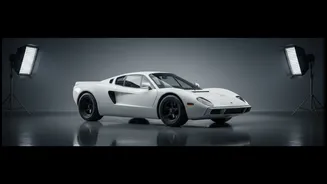
officially recognizes Ruf as an independent automaker. This is a crucial distinction. Ruf doesn't just modify cars; for decades, it has built its own machines, often using unmarked Porsche chassis as a starting point, culminating in icons like the 1987 CTR “Yellowbird,” a car that famously hit 211 mph and put the established supercar hierarchy on notice. The company, still family-owned, has a reputation for engineering purity and raw driving pleasure, a legacy that provides the perfect context for its latest creation.
What Exactly is an 'Erprober'?
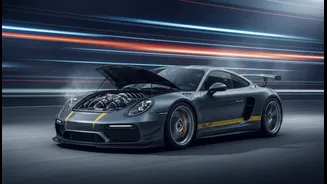
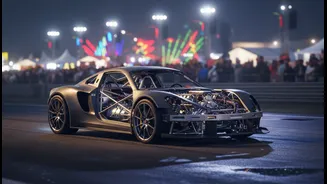
The vehicle in question is internally named the “Erprober,” a German word that translates simply to “tester.” It’s a development mule—a rolling laboratory built not for showrooms, but for engineers. Its purpose is to validate new technology under real-world stress. In this case, the Erprober is testing a monumental new piece of hardware: a completely new, in-house designed, twin-turbocharged 4.8-liter flat-eight engine, designated the B8. The engine, a configuration with racing history but virtually unseen in a road car, produces over 1000 horsepower and is paired with a six-speed manual transmission. To accommodate this beast, Ruf has taken the chassis of its CTR3 supercar and lengthened it, creating a machine that is pure function. It exists solely to push this new powertrain to its absolute limit.
The Allure of the Unfinished
This is where the argument begins. A launch-edition car is a compromise. It has been softened for daily usability, its engine note muffled to meet regulations, its interior padded with sound-deadening and luxury features. A development car like the Erprober has none of these constraints. It is the purest expression of the engineer's vision. Every component exists for a single purpose: performance. There are no focus groups, no marketing considerations, just the relentless pursuit of speed and durability. This rawness is its most compelling feature. It offers a direct, unfiltered connection to the machine and the minds that created it. Car enthusiasts often dream of this purity—the 'what if' scenario where a car is built without compromise. The Erprober is that 'what if' made real.
A Symphony of Purpose
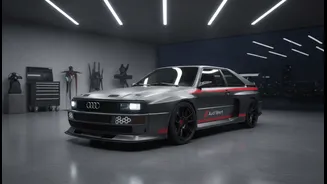
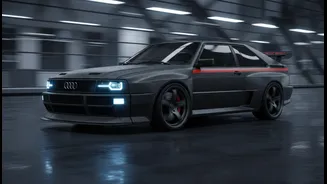
Debuted at the Goodwood Festival of Speed, the B8 Erprober is a visual feast of function-first design. It wears a matte black finish with a livery inspired by the original Yellowbird, its graphics tracing the figure-eight of its new engine. The bodywork is stretched and modified not for aesthetics, but because the massive flat-eight engine requires it. You can sense the hundreds of hours of testing, the data-driven adjustments, and the singular focus on mechanical excellence. This isn't just a car; it's a story told in carbon fiber and raw power. While concept cars are often just visual mock-ups designed to test public reaction, a development mule is a true, functional prototype, built to be driven hard. It's the soul of the final product, laid bare before it's dressed up for the public.
The Soul of the Machine
The Ruf B8 Erprober reminds us that excitement in the automotive world isn't always found in a polished final product. Sometimes, it’s in the process. It's in the visible welds, the stripped-down interior, and the deafening roar of an engine freed from the constraints of mass production. This car is a testament to an era where engineering prowess, not battery capacity, defines the pinnacle of performance. It makes a powerful statement against the silent, seamless efficiency of the electric age, reminding us of the visceral, mechanical thrill that made us fall in love with cars in the first place. While a future Ruf production car will eventually house this incredible engine, it will inevitably be tamed. But for a brief, glorious moment, the Erprober exists as a wild, untamed expression of what is possible, proving that the journey can indeed be more exciting than the destination.