




A Cosmic End Game
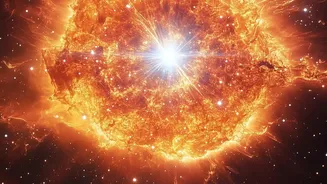
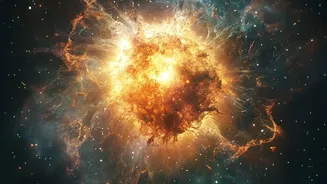
When a massive star, many times the size of our sun, exhausts its nuclear fuel, its life ends in a spectacular fashion. Without the outward push of fusion, gravity wins. The star's core collapses in on itself in a fraction of a second, creating unimaginably
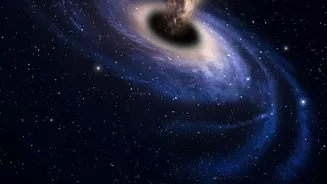
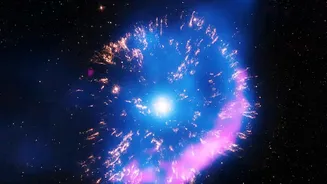
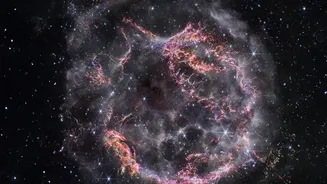
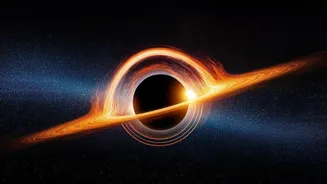
high temperatures and pressures. This catastrophic event has two potential outcomes: a brilliant supernova explosion that leaves behind a dense neutron star, or a failed explosion where the core continues to collapse, forming a black hole from which not even light can escape. For decades, astrophysicists have worked to understand what tips the scales between these two fates. A new study from the University of Copenhagen suggests the answer may lie with a long-overlooked property of a particle so small it's often called a 'ghost particle'.
The Elusive 'Ghost Particle'
Neutrinos are fundamental particles, but they are notoriously difficult to study. They have almost no mass, no electric charge, and barely interact with other matter. Trillions of them pass through your body every second without leaving a trace. However, during a star's core collapse, they are produced in staggering numbers, carrying away 99% of the event's colossal energy. Scientists have long known that neutrinos come in three different types, or "flavors": electron, muon, and tau. They can also change from one flavor to another in a process called neutrino oscillation or flavor conversion. Until recently, most models assumed this flavor-changing had little effect on the star's ultimate fate. The new research challenges that assumption directly.
Simulating a Star's Final Moments
Incorporating the complex physics of neutrino flavor conversion into models of stellar death is incredibly difficult and computationally expensive. This is where the new study, published in the journal Physical Review D, breaks new ground. Researchers led by Mariam Gogilashvili and Irene Tamborra at the Niels Bohr Institute developed a way to factor in these flavor changes. They then ran a massive suite of 195 simulations, modelling the collapse of stars ranging from nine to 120 times the mass of our sun. By comparing models with and without neutrino flavor conversion, they could see what difference it made. The results were dramatic.
A Fateful Flip
The simulations revealed that when neutrino flavor conversion is included, many stars that were predicted to explode as supernovae instead fail and collapse into black holes. The effect was particularly strong for stars between 16 and 30 times the mass of the sun. The flavor-changing neutrinos alter how energy is distributed in the collapsing core. This change can create a hotter, more neutron-rich environment that ultimately makes it harder for the star to rebound in a supernova explosion, tipping the balance toward black hole formation. According to Gogilashvili, seeing a whole range of stars flip from exploding to failing when the new physics was included was a clear sign that this process cannot be ignored.
Solving Cosmic Mysteries
This discovery could help solve several long-standing puzzles in astronomy. For instance, scientists observe fewer supernovae in the universe than theoretical models predict. If many massive stars are quietly collapsing into black holes instead, it would help explain this discrepancy. It could also explain why astronomers have seen massive red supergiant stars seemingly vanish without the expected supernova flash—they likely collapsed directly into a black hole, a process this new neutrino physics helps to explain. Furthermore, the study suggests that the neutron stars which do form might be less massive than previously thought, aligning better with recent observations.