

The Scale of an Eruption: VEI
To understand the 'largest' eruptions, volcanologists use the Volcanic Explosivity Index (VEI). It’s a logarithmic scale from 0 to 8, meaning each whole number represents a tenfold increase in the volume of ejected material. An eruption's impact isn't
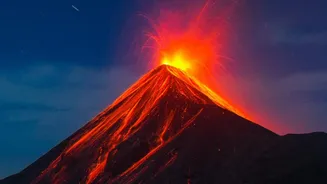
just about its VEI rating; factors like location, ash composition, and eruption style play crucial roles in how much it disrupts the world. A moderately sized eruption in a critical location can cause more chaos than a larger one in a remote area. The 21st century has already witnessed several eruptions that serve as powerful case studies in geological disruption.
2010: The Icelandic Ash Cloud That Grounded Europe
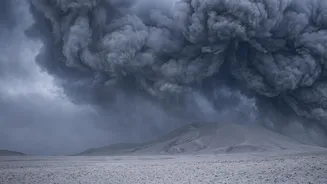
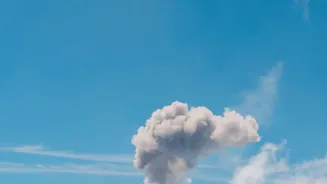
In April 2010, a relatively moderate VEI 4 eruption from Iceland's Eyjafjallajökull volcano had an outsized impact on the world. While not colossal in scale, its timing and location were perfect for causing chaos. The volcano's position under a glacier resulted in a fine, glassy ash that was particularly dangerous to jet engines. Carried by the jet stream directly over Europe, this ash cloud led to the largest shutdown of airspace since World War II. Over a period of about eight days, more than 100,000 flights were cancelled, affecting around 10 million passengers. The economic fallout was immense, with the airline industry losing an estimated $1.7 billion and knock-on effects crippling industries from Kenyan flower exports to manufacturing supply chains. It was a stark lesson in the vulnerability of our globalised travel network.
2010: The Devastating Human Cost of Merapi
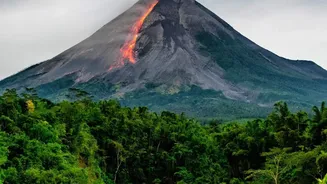
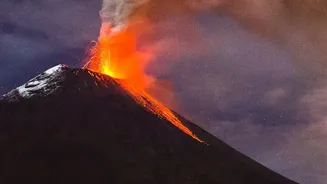
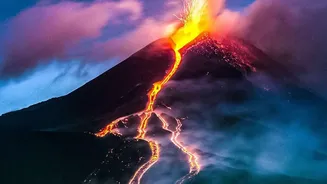
In the same year, another VEI 4 eruption provided a tragic reminder of the immediate human danger volcanoes pose. Mount Merapi, one of Indonesia's most active and dangerous volcanoes, erupted violently in October and November. Unlike Eyjafjallajökull's disruption, Merapi's was a story of direct, localised devastation. Fast-moving pyroclastic flows—scorching clouds of ash and gas—swept down the volcano's slopes, engulfing entire villages. The eruption ultimately killed more than 350 people and forced the evacuation of over 350,000 residents. While its ash plumes also caused regional flight disruptions across Java, the primary impact of the 2010 Merapi event was the profound human tragedy and the massive humanitarian response required.
2011: The Ash That Circled the Southern Hemisphere
Just a year later, the Puyehue-Cordón Caulle volcanic complex in Chile unleashed a powerful VEI 5 eruption. This event demonstrated the truly global reach of a major volcanic blast. The enormous ash plume was injected high into the atmosphere and caught by strong westerly winds. Within two weeks, the ash cloud had completely circled the globe, causing widespread travel chaos across the Southern Hemisphere. Flights were grounded for days at a time in Argentina, Uruguay, Australia, and New Zealand as the plume drifted overhead. The event highlighted how a single eruption could disrupt commerce and travel on multiple continents, forcing airlines to develop new strategies for tracking and avoiding volcanic ash on a planetary scale.
2022: Tonga’s Unprecedented Underwater Blast
The largest eruption of the 21st century to date occurred in January 2022, when the Hunga Tonga-Hunga Ha'apai submarine volcano exploded with a force estimated to be hundreds of times more powerful than an atomic bomb. Rated a VEI 5 to 6, this was the biggest instrumentally recorded blast in modern history. The eruption sent an atmospheric shockwave that circled the Earth multiple times and triggered a tsunami that caused damage across the Pacific, from Tonga to Peru. The explosion sent a plume of ash and, uniquely, a massive volume of water vapour, soaring to a record height of 58 kilometres into the mesosphere. This unprecedented injection of water into the stratosphere has scientists studying its potential long-term effects on the climate and ozone layer, showcasing a new and alarming way volcanoes can disrupt our world.