




The Blueprint: Goldfinger (1964)
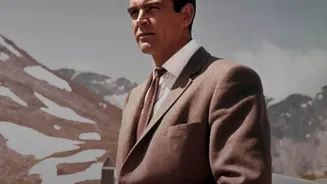
To understand James Bond, you have to start with Sean Connery. While 'Dr. No' and 'From Russia with Love' were excellent spy thrillers, 'Goldfinger' is where the formula was perfected. It has it all: the Aston Martin DB5 packed with gadgets, a larger-than-life
villain in Auric Goldfinger, and an iconic henchman in Oddjob. Connery’s effortless mix of charm, wit, and lethality defined the character for generations. 'Goldfinger' is not just a great Bond movie; it's the blueprint for the modern action blockbuster. Critics and fans consistently rank it as one of the best in the entire series, making it the essential starting point for any 007 marathon.
The Romantic Tragedy: On Her Majesty's Secret Service (1969)
George Lazenby's single outing as Bond is one of the most unique and emotionally resonant films in the franchise. Often overlooked at the time, 'On Her Majesty's Secret Service' has been re-evaluated by fans and critics as a masterpiece. It features a more vulnerable and human Bond who genuinely falls in love and gets married. The film's heartbreaking conclusion gives the character a depth that wouldn't be explored again in such detail until the Daniel Craig era. Its stunning ski-chase sequences and compelling love story make it a standout entry that shows a different side of the seemingly invincible agent.
The Fun-Filled Spectacle: The Spy Who Loved Me (1977)
If Connery was cool, Roger Moore was all about having fun. His tenure is known for its raised-eyebrow humor and increasingly outlandish plots, and 'The Spy Who Loved Me' is the pinnacle of his era. From the unforgettable opening sequence where Bond skis off a cliff and deploys a Union Jack parachute, the film is pure spectacle. It features the formidable henchman Jaws, a submersible Lotus Esprit, and a plot involving stolen nuclear submarines. Moore’s Bond was less of a cold-blooded killer and more of a charming adventurer, and this film perfectly captures the globe-trotting escapism that defined his seven-film run.
The Gritty Precursor: The Living Daylights (1987)
Long before Daniel Craig brought a harder edge back to the role, Timothy Dalton delivered a darker and more serious interpretation of 007. 'The Living Daylights' introduced audiences to a Bond who was weary of his profession and more aligned with the character from Ian Fleming's novels. Dalton's portrayal was a stark contrast to Moore's lightheartedness, offering a grounded, Cold War thriller. While his two-film tenure was brief, his performance is now widely appreciated for foreshadowing the franchise's shift towards more realistic and intense storytelling.
The Modern Revival: GoldenEye (1995)
After a six-year hiatus, the longest in the series' history at that point, James Bond needed to prove he was still relevant in a post-Cold War world. 'GoldenEye' did that and more. Pierce Brosnan stepped into the role with a perfect blend of Connery's suaveness and Dalton's seriousness. The film addressed Bond's status as a 'relic of the Cold War' head-on, introduced a formidable female M played by Judi Dench, and featured spectacular action set pieces. For many who grew up in the '90s, 'GoldenEye' was their introduction to 007, and it remains a high point for its successful revival of the franchise.
The Definitive Reboot: Casino Royale (2006)
Following the excess of the later Brosnan films, the franchise needed a complete reset. 'Casino Royale' delivered a raw, brutal, and emotionally complex James Bond. Daniel Craig's debut showed a rookie 00 agent earning his license to kill. The film stripped away the gadgets and focused on character, with a stunning parkour chase, a high-stakes poker game, and a tragic love story that would define Craig's entire five-film arc. It not only reinvented Bond for the 21st century but also stands as one of the best action films ever made, proving the character's enduring ability to adapt and evolve.