





Reading a Galaxy's Fossil Record
When astronomers talk about a galaxy “losing activity,” they are typically referring to its rate of star formation. Galaxies are cosmic nurseries, constantly turning vast clouds of gas and dust into new stars. The most massive of these stars burn hot
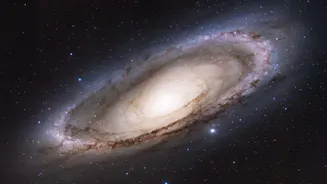
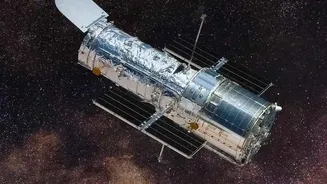
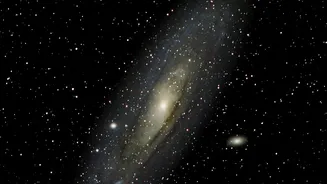
and blue but have very short lives, meaning their presence is a tell-tale sign of recent star birth. Older, more stable stellar populations tend to glow with a redder hue. By mapping the color and age of millions of stars, scientists can create a 'fossil record' of a galaxy's past. A new study has done just that for Andromeda, using two massive Hubble surveys to analyze approximately 200 million individual stars across two-thirds of its disk. The findings paint a picture of a galaxy in transition, moving from a highly active past to a more quiescent future.
Mapping the Slowdown
The comprehensive new map reveals that star formation in Andromeda has been on a steady decline for the last 500 million years. Researchers calculated that half a billion years ago, the galaxy was producing stars at a rate of about one solar mass per year. That rate has since plummeted, now standing at just one-fifth of a solar mass annually. The decline has become particularly steep in the last 40 million years. This slowdown isn't happening uniformly across the galaxy. The analysis pinpointed that most of the recent star-making activity has been concentrated in a prominent ring about 32,000 light-years from the galactic center, a feature some have nicknamed the 'ring of fire'. It is the fading of this specific ring that is driving much of Andromeda's overall decline in activity.
A Tale of Two Galaxies?
So, what’s causing Andromeda to slow down? One initial theory might be that it's running out of the raw gas needed to build new stars. However, the data suggests this isn't the case. Instead, it seems the galaxy is naturally winding down after a more energetic period. Previous studies indicate that Andromeda experienced a massive burst of star formation about two billion years ago, likely triggered by a merger or interaction with another galaxy. Like an athlete taking a breather after a marathon, the galaxy may simply be entering a quieter phase. However, scientists are also investigating another potential culprit: Andromeda's small satellite galaxy, M32. Some evidence suggests that a past interaction with M32, which may have swept through Andromeda's disk around 60 million years ago, could have disrupted gas clouds and contributed to the slowdown in specific regions.
A Glimpse into Our Own Future
Studying the life cycle of Andromeda is more than just an academic exercise; it provides a crucial window into how large spiral galaxies like our own Milky Way evolve. Andromeda is our closest major galactic neighbor, located about 2.5 million light-years away, making it the perfect laboratory for detailed observation that isn't possible with more distant galaxies. The processes happening there—mergers, bursts of star birth, and eventual decline—are part of a cosmic story that our own galaxy is also living. By understanding why Andromeda's star formation is fading, astronomers can refine their models of galactic evolution and better predict the long-term future of the Milky Way. The fates of these two galaxies are already intertwined, as they are on a collision course set to merge in about 4.5 billion years, an event that will trigger an immense new wave of star formation before they eventually settle into a new, larger galaxy.