


A New Digital Mapmaker for the Moon
At the heart of this initiative is the NASA-IBM Lunar Foundation Model, one of the first AI tools built specifically to analyze the Moon's surface. Think of it less like a traditional computer program and more like a brilliant digital cartographer. Instead
of being designed for one specific task, this 'foundation model' was pre-trained on a colossal amount of unlabeled data. This broad training gives it a versatile knowledge base that can be quickly fine-tuned for many different scientific jobs, from mapping craters to searching for resources. The partnership leverages decades of NASA's public lunar data and IBM's expertise in building scalable AI systems.
Training an AI on Lunar Secrets
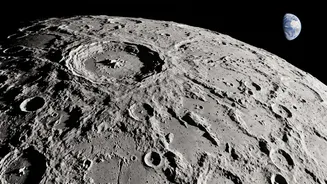
To create the model, NASA provided a treasure trove of data, primarily from its Lunar Reconnaissance Orbiter (LRO), which has been mapping the Moon for over a decade. This included roughly 2 million high-resolution image tiles. IBM's role was to apply its advanced AI framework to train the model on this vast dataset, teaching it to recognize geological features and patterns that might be missed by the human eye. The result is a tool that can perform complex analyses more efficiently than manual methods, significantly speeding up the pace of discovery. For example, it can identify craters or unusual volcanic formations with greater accuracy, helping scientists piece together the Moon's complex history.
Why 'Open-Source' Is a Game Changer
Perhaps the most significant aspect of this project is its open-source nature. The entire model and its codebase have been made publicly available on Hugging Face, a popular platform for the AI community. This decision transforms the tool from a proprietary NASA asset into a global resource. Scientists, researchers, and even students from around the world can now access, use, and build upon this cutting-edge AI. This approach democratizes lunar science, fostering a collaborative environment where new discoveries can be made faster. By sharing the tool openly, NASA and IBM are inviting the global community to help solve the challenges of lunar exploration.
From Moon Missions to Earthly Applications
The potential applications of this AI are immense and extend beyond just our celestial neighbor. A key task for the model is to help locate potential deposits of water ice, particularly in the permanently shadowed regions near the Moon's poles. This is crucial for NASA's Artemis program, as ice could provide drinking water, breathable oxygen, and even rocket fuel for future astronauts. But the underlying technology isn't limited to the Moon. This is part of a series of models from NASA and IBM, including others designed for Earth observation to monitor climate change, track deforestation, and predict crop yields. The same foundational principles could one day be applied to mapping Mars or other planets.