





Since his return to the presidency, Luiz Inácio Lula da Silva has emphatically declared 'Brazil is back'. After a period of relative isolation, the country is re-engaging with the world, pursuing a foreign policy that is ambitious and pragmatic.
A Return to Multilateralism
A core
tenet of Lula's foreign policy is the restoration of Brazil's role in multilateral forums. In contrast to his predecessor's more inward-looking and bilateral approach, Lula has made a point of re-engaging with international organizations and partners. His administration has rejoined regional blocs like the Union of South American Nations (UNASUR) and the Community of Latin American and Caribbean States (CELAC). This flurry of diplomatic activity, including hosting the G20 and the COP30 climate conference, signals a clear intent to reclaim Brazil's status as a significant global player. The strategy is one of active non-alignment, positioning Brazil as a sovereign counterweight to US ambition in the region and a constructive force in global governance.
Navigating the Giants: US and China
Brazil's relationships with the world's two largest economies, the United States and China, are a delicate balancing act. Tensions with the US have been notable, marked by disagreements over trade tariffs and differing geopolitical approaches. Despite this, pragmatic cooperation remains possible, driven by shared interests in areas like security and access to Brazil's critical minerals. At the same time, ties with China, Brazil's largest trading partner, have deepened. Bilateral trade reached record highs in the first nine months of 2026. Lula has pursued closer economic ties and investment with Beijing, framing it as part of a strategy to diversify partnerships and maintain strategic autonomy. This approach has made China a key pillar in Brazil's foreign policy, particularly within the BRICS framework.
Champion of the Global South
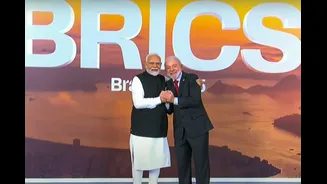
Lula has long envisioned Brazil as a leader of the 'Global South'. A central element of this vision is strengthening the BRICS bloc (Brazil, Russia, India, China, South Africa) as a platform for emerging economies. Lula sees BRICS as a crucial geopolitical development that can help reshape global trade and create a more balanced world order. His government supports expanding the group's financing mechanisms, like the New Development Bank, and promoting the use of local currencies in trade to reduce dependence on the US dollar. This push for South-South cooperation is about more than just economics; it's a strategic effort to increase the influence of developing nations in global decision-making bodies like the UN and IMF.
The Amazon as a Diplomatic Tool
Under Lula, environmental policy has become a cornerstone of Brazil's foreign policy. After years of rising deforestation, his administration has made significant strides in protecting the Amazon rainforest, a critical carbon sink for the planet. Deforestation rates in the Amazon have fallen dramatically, reaching historically low levels. This progress has unlocked international funding, with nations like Germany, Norway, and the Netherlands contributing to the Amazon Fund to support conservation efforts. By positioning Brazil as a leader in climate action and hosting the COP30 climate summit in the Amazonian city of Belém, Lula has successfully used environmental stewardship to enhance Brazil's soft power and global standing.
Implications for India
For India, Lula's presidency offers a partner with a shared vision for a multipolar world. The India-Brazil Strategic Partnership, established in 2006 during Lula's first tenure, has been reenergized. Prime Minister Narendra Modi and President Lula have expressed a commitment to deepening cooperation across various fields. Bilateral trade is on an upward trajectory, with an ambitious target of $30 billion. Both nations are key members of BRICS and the G20, working together to amplify the voice of developing countries on global issues like UN reform and climate change. Cooperation is also expanding into new areas like critical minerals, digital technologies, and defence, reflecting a mutual interest in diversifying supply chains and building a robust partnership between two of the Global South's largest democracies.