





First, Understanding the 'Invisi-Shield'
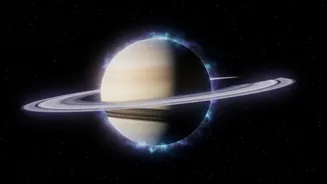
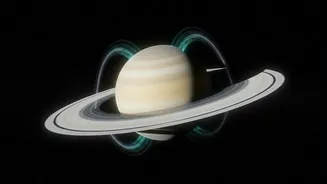
Before diving into the data, it's essential to understand what scientists are looking for. Every planet with a magnetic field, including Earth, is surrounded by a vast, invisible bubble called a magnetosphere. This shield, generated by the motion of fluid
deep inside the planet, deflects the majority of harmful, high-energy particles streaming from the Sun, known as the solar wind. Without it, a planet's atmosphere could be stripped away. Saturn’s magnetosphere is a gigantic and complex system, influenced not just by the Sun, but also by its own rapid rotation and the material spewed into space by its moons, particularly Enceladus. Scientists study its shape, strength, and behaviour to learn about what’s happening deep inside Saturn’s core and how the entire system interacts.
The Treasure Trove: What Cassini Collected
The Cassini orbiter was equipped with a suite of 12 sophisticated instruments designed for this very purpose. For studying the magnetosphere, two were especially critical: the Magnetometer (MAG) and the Cassini Plasma Spectrometer (CAPS). Think of the MAG as a highly advanced compass that measures the strength and direction of magnetic field lines wherever it goes. The CAPS instrument, meanwhile, acted as a 'taster', sampling the electrically charged gas, or plasma, caught within that magnetic field. It could determine the composition, temperature, and direction of flow of these particles. Together, these instruments didn't just 'see' the invisible magnetic field; they felt its structure and tasted the environment it contained, sending back reams of numbers representing vectors, particle counts, and energy levels.
The Analyst's Toolkit: From Numbers to Knowledge
This is where the 'reading' begins. Scientists don't simply look at a screen of raw numbers. The process involves several complex steps. First, the data must be calibrated and cleaned to account for the spacecraft's own magnetic interference. Then, scientists use powerful computer models and software to translate the data into visualisations. They can generate 3D maps of the magnetic field lines, track the flow of plasma currents, and identify where particles are being accelerated. The 'New Saturn Magnetosphere Analysis' mentioned in the headline refers to these evolving computational techniques and the ongoing analysis of the unique data from Cassini's final orbits, known as the 'Grand Finale'. During this phase, the spacecraft dived into the unexplored region between Saturn and its rings 22 times, providing an unprecedented, high-resolution look at the innermost magnetic environment.
Decoding the Puzzles
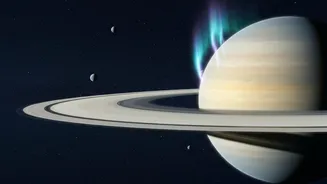
The analysis has uncovered fascinating and baffling new information. One of the biggest mysteries is that Saturn’s magnetic field is almost perfectly aligned with its rotational axis, with a tilt of less than 0.01 degrees. This directly challenges existing theories of how planetary magnetic fields are generated, which require a significant tilt. Scientists also found that Saturn's rapid 10.7-hour day and the plasma from its moons have a more powerful influence than the solar wind, dragging key features of the magnetosphere into unexpected positions. Recent analysis from 2026 has shown that the 'cusps'—funnel-like openings near the poles where solar wind can leak in—are skewed far into the afternoon side of the planet, unlike on Earth where they are centred around noon. These findings force scientists to rethink the physics of giant planet magnetospheres.
The Legacy of the Grand Finale
The data from the Grand Finale orbits, in particular, is the gift that keeps on giving. By flying so close to the planet, Cassini detected a previously unknown electrical current system connecting the rings to the top of Saturn's atmosphere. It also discovered a new radiation belt close to the planet. These up-close measurements provided direct samples of 'ring rain'—a phenomenon where complex organic compounds and water from the rings fall into the planet's atmosphere. Each new finding is a clue, helping researchers piece together a more complete picture of how the entire Saturnian system works, from its deep interior to the outermost reaches of its magnetic influence.