




Humanity's Farthest Emissaries
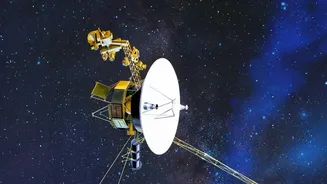
Launched in 1977, the twin Voyager 1 and 2 spacecraft are humanity's longest-operating and most distant explorers. Originally designed for a five-year mission to study Jupiter and Saturn, their journey was extended, with Voyager 2 going on to become the only
spacecraft to visit Uranus and Neptune. Today, both probes are navigating interstellar space, the region beyond the protective bubble of our sun. They continue to send back invaluable data from this uncharted territory, powered by radioisotope thermoelectric generators. These nuclear batteries have been incredibly reliable, but their power output steadily drops by about four watts each year, forcing NASA's engineers into a long and careful process of energy conservation.
What Is the 'Big Bang' Fix?
The dramatic nickname refers not to a single software patch, but to a carefully choreographed power-shuffling maneuver. To save precious watts, engineers must turn off certain components. The challenge is that some of these components, including dedicated heaters, are essential for keeping the spacecraft's fuel lines from freezing in the extreme cold of interstellar space. The 'Big Bang' fix involves simultaneously switching off power-hungry heaters and devices, and then activating other, lower-power components that can provide enough residual warmth to keep the probe alive. This delicate swap, performed across a 20-hour light-delay, frees up enough power to keep Voyager 2’s remaining three science instruments operating for at least another year. Without it, another instrument would have had to be shut down before the end of 2026.
Why Test on Voyager 2 First?
The decision to perform this risky operation on Voyager 2 before Voyager 1 was a strategic one, based on the relative health of the two aging probes. Voyager 1 is in a more precarious state; it has less power in reserve and recently suffered a serious data glitch that took months to resolve. Voyager 2, while also facing dwindling power, is considered the healthier of the two. By testing the 'Big Bang' procedure on the more stable spacecraft, engineers could better assess the maneuver's effectiveness and any unforeseen consequences. It was a calculated risk to use the healthier 'patient' to test a cure before administering it to the one in more critical condition. This approach allowed the team at NASA's Jet Propulsion Laboratory to verify the fix before attempting it on the more distant and fragile Voyager 1.
The Stakes for Voyager 1
The need for the fix is even more urgent for Voyager 1. It is farther away, at over 25 billion kilometers, and has only two remaining active science instruments after another had to be shut down earlier this year to manage its declining power. An unexpected power dip during a maneuver in February brought the probe close to an automated shutdown, highlighting its vulnerability. NASA has already begun preliminary tests for implementing the 'Big Bang' fix on Voyager 1, with hopes of extending its mission and perhaps even reactivating a recently silenced instrument. However, engineers caution that even though the probes are twins, 49 years of separate travel mean they no longer behave identically, and success on Voyager 2 does not guarantee the same outcome for its sibling.