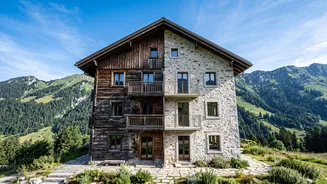








Imagine sleeping with your head in Switzerland and your feet in France. At the Hotel Arbez Franco-Suisse, this isn't a gimmick; it's a reality born from a diplomatic quirk and one businessman's incredible foresight over 160 years ago.
A Border Redrawn
The story begins
in 1862 with the Treaty of Dappes. France, under Napoleon III, and the Swiss Confederation agreed to a land swap to resolve a long-standing border dispute over the strategic Dappes Valley. This adjustment would redraw the boundary, cutting directly through the small French village of La Cure. Crucially, the treaty included a clause stating that any existing buildings straddling the new border would be left undisturbed. This detail might have been a simple footnote in history, but one local entrepreneur saw it not as a problem, but as a golden opportunity.
An Entrepreneur's Clever Gambit
A French businessman named Ponthus owned a plot of land right where the new border was set to pass. Seizing his chance in the window between the treaty's signing in December 1862 and its final ratification in February 1863, he hastily constructed a three-story building. His goal was to have a structure standing before the new border became official, thus grandfathering his building into a unique two-nation status. He succeeded, and the building was designed for cross-border commerce from the very start, with a grocery shop opened on the Swiss side and a bar on the French side.
Life in Two Countries at Once
In 1921, the building was purchased by Jules-Jean Arbez, who converted it into the hotel that still bears his name today. The international border runs through the hotel in the most curious ways. The dining room is split, with diners eating in two different countries at the same table. The kitchen is also divided, requiring careful coordination. Several guest rooms are bisected by the line; the honeymoon suite famously features a bed where couples can sleep in both France and Switzerland simultaneously. In another room, the bedroom is in Switzerland, but the bathroom is in France, making a trip to the toilet an international journey.
A Haven in Times of Conflict
This unique geographical status gave the hotel an important role during World War II. After the German occupation of France, Nazi soldiers could enter the French side of the hotel but were forbidden from setting foot on the neutral Swiss side. The hotel’s main staircase provided a critical escape route: it started in France but ended on the upper floor in Switzerland. This meant the upper rooms were inaccessible to German troops and became a safe haven for refugees, downed pilots, and members of the French Resistance, sheltered by thenndowner Max Arbez.
A Landmark of Diplomacy and Charm
The hotel’s role in history didn’t end there. In 1962, its neutral meeting ground was used for preliminary negotiations for the Évian Accords, which led to Algeria's independence from France. Today, the Hotel Arbez Franco-Suisse is still run by the Arbez family. It remains a popular destination for tourists fascinated by its story, who come to experience the novelty of straddling a border. The hotel pays taxes to both countries and stands as a testament to how a line on a map, combined with quick thinking, created one of the most unique and historically significant hotels in the world.