

As artificial intelligence reshapes industries across India, many wonder about the future of their jobs. But forecasts for 2030 suggest a surprising twist: as AI handles routine tasks, uniquely human skills are becoming more valuable than ever.
The New AI-Powered Workplace
The conversation
around artificial intelligence is shifting from replacement to collaboration. The 'AI-enabled job' is not about a machine taking over, but a professional being augmented by powerful tools. Think of it as a 'co-pilot' economy, where AI handles the heavy lifting of data analysis, pattern recognition, and routine administrative work, freeing up human workers to focus on what they do best. In India, where the tech workforce is over five million strong, this transition is already underway. Companies are rapidly integrating AI to screen resumes, analyse data, and manage customer service queries, which doesn't eliminate the need for human resources but changes the nature of their roles. The focus moves from performing repetitive tasks to overseeing, interpreting, and applying the outputs of AI systems.
The 2030 Skills Blueprint
So, what skills will matter most by 2030? Forecasts from institutions like the World Economic Forum and analysis by business leaders point to a blend of technical literacy and deeply human capabilities. On the one hand, skills in 'AI and big data' are ranked as the fastest-growing necessity. On the other hand, 83% of business leaders agree that the rise of AI makes human skills more important, not less. The consensus 'skills forecast' for the next decade emphasises a dual proficiency. Professionals will need a foundational understanding of AI to work with the tools, but their career resilience will depend on abilities that machines cannot replicate: creativity, critical thinking, ethical judgement, and emotional intelligence. For India's young and vast workforce, this signals a clear direction for personal and professional development.
Human Experience as a Core Asset
This brings us to the core of the 2030 forecast: the irreplaceable value of human experience. While AI can process information at superhuman speed, it lacks a moral compass, empathy, and a true understanding of human context. This is where 'emotional intelligence' (EI) becomes a critical workplace skill. EI is the ability to recognise and manage your own emotions and influence those of others. It’s the empathy a doctor needs when delivering an AI-assisted diagnosis, the judgement a manager uses to navigate team dynamics after an AI-driven performance review, and the creativity a marketing professional employs to build a campaign from AI-generated insights. These are not 'soft skills'; in an AI-saturated world, they are strategic advantages that foster trust, facilitate collaboration, and drive innovation.
A Powerful Partnership, Not a Competition
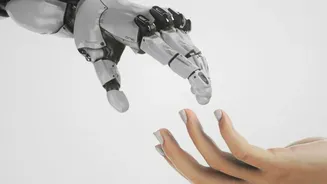
The most successful professionals of the next decade will not be those who compete against AI, but those who partner with it. This synergy is already visible. A financial analyst uses AI to flag anomalies in market data, but applies critical thinking and experience to determine the strategic response. A software developer uses an AI co_pilot to write boilerplate code, freeing up mental energy for creative problem_solving and architectural design. In each case, AI handles the 'what' while the human provides the 'why' and 'how'. This human_in_the_loop model ensures that technology serves human values. It mitigates risks like algorithmic bias and builds a more humane and effective workplace by combining machine efficiency with human oversight and ethical stewardship.