






A Collision of Tectonic Plates
The primary reason for Japan's seismic activity is its location on the Pacific Ring of Fire, an area where several of Earth's tectonic plates converge. Specifically, the Japanese archipelago sits at the junction of four major plates: the Pacific, North
American, Eurasian, and Philippine Sea plates. These massive crustal slabs are in constant motion, grinding against and sliding under one another in a process called subduction. As the denser oceanic plates—the Pacific and Philippine Sea—plunge beneath the continental plates, immense stress builds up. When this stress is suddenly released, the ground shakes, causing an earthquake. This complex and violent underground interaction is responsible for the fact that Japan experiences around 1,500 perceptible earthquakes annually and accounts for a significant percentage of the world's total seismic energy release.
A History Written in Tremors
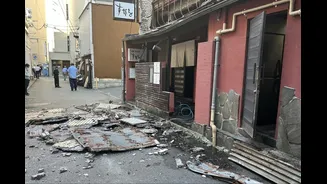
This geological reality has shaped Japan's history and national consciousness. Major earthquakes are not just isolated incidents but recurring events that have periodically reshaped society. The Great Kanto Earthquake of 1923, for example, devastated Tokyo and resulted in over 100,000 fatalities, largely due to the fires that followed. More recently, the Great East Japan Earthquake of March 2011, a magnitude 9.0 undersea quake, triggered a catastrophic tsunami and the Fukushima nuclear disaster, claiming nearly 20,000 lives. These events, along with others like the 1995 Great Hanshin Earthquake in Kobe, serve as powerful reminders of the ever-present danger and have driven a relentless pursuit of resilience. This history has fostered what some call a culture of catastrophe, where preparedness is a deeply ingrained value.
Engineering a Resilient Nation
In response to this constant threat, Japan has become a world leader in earthquake-resistant engineering. The nation's building codes are among the strictest globally, having been progressively tightened after every major quake. Modern Japanese buildings are designed not to rigidly resist an earthquake's force but to move with it. This philosophy is rooted in ancient traditions, like the flexible, nail-free joinery of wooden pagodas, which have survived for centuries. Today, this is achieved through cutting-edge technology. High-rises often employ base isolation systems, where thick rubber pads separate the building from its foundation, allowing the ground to move while the structure remains relatively stable. Other technologies include dampers that act like shock absorbers and even giant pendulum-like mechanisms inside skyscrapers to counteract swaying.
A Culture of Constant Preparedness
Technology is only one part of the equation. Japan's resilience is also built on a foundation of social preparedness. From a young age, citizens are taught how to react when the ground shakes. Regular drills are conducted in schools and workplaces. Most households keep an emergency kit, known as a "bousai bag," stocked with essentials like water, food, and a flashlight. A key element of this system is the Japan Meteorological Agency's Earthquake Early Warning (EEW) system. Using a dense network of over 4,000 seismometers, the system detects the initial, faster-moving P-waves of an earthquake and broadcasts a warning seconds before the more destructive S-waves arrive. These few seconds are enough to allow people to take cover, for trains to brake, and for factory equipment to be shut down, demonstrably saving lives.